
Rapid Review·Cardiovascular
Select any text to highlight it or add a note.
Cardiomyopathy
T2High yieldAnomalous Aortic Origin of a Coronary Artery
Focus on
The other cause of exertional sudden death in a young athlete — the one with no murmur and a normal resting ECG. A coronary arising from the wrong sinus and running between the aorta and pulmonary artery gets squeezed during exercise. Coronary CT angiography finds it; surgery fixes the high-risk anatomy.
Key takeaways
Why it matters
Sudden death in young athletes
a common cause (about one third of cases).Under 35
sudden death usually comes from structural heart disease, with a ventricular tachyarrhythmia as the terminal event.The dangerous anatomy
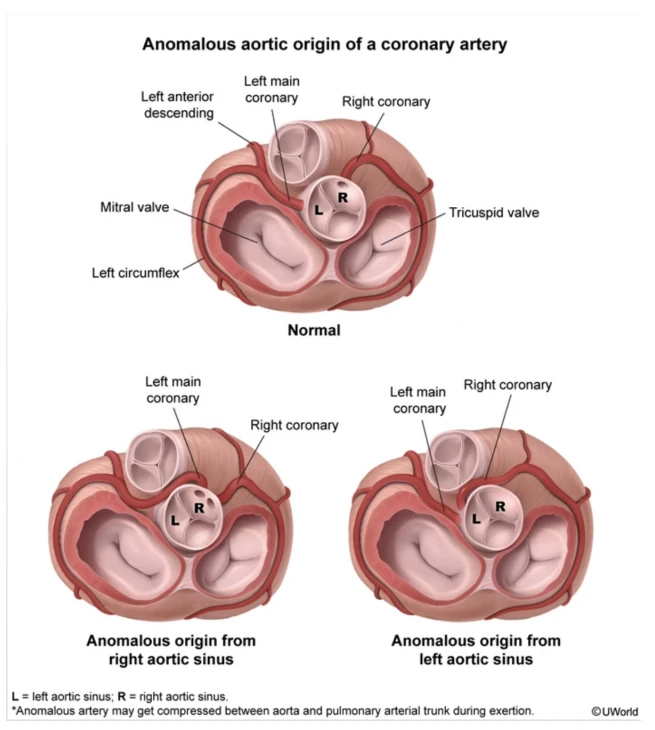
What this shows
Two high-risk origins
the left main from the right aortic sinus, or the right coronary from the left sinus.Two mechanisms on exertion
the anomalous artery takes a sharp curve that limits flow.- It runs between the aorta and pulmonary artery, where exercise compresses it.
Clinical features
Exertional symptoms
exertional angina, lightheadedness or syncope.- Some patients die suddenly with no prior symptoms.
Diagnosis
Coronary computed tomography (CT) angiography or magnetic resonance (MR) angiography
the test of choice.The resting electrocardiogram (ECG) is typically normal
echocardiography can miss or mischaracterize the anomaly.What a normal workup excludes
a normal ECG argues against Wolff-Parkinson-White, Brugada and long-QT syndromes; a normal ECG, echo and examination (no murmur) argues against HCM.A 17-year-old basketball player has exertional chest pain and one episode of syncope during practice. The examination is normal with no murmur, and the resting ECG and echo are unremarkable. Which test comes next?
Suspect an anomalous aortic origin of a coronary artery (exertional angina and syncope, no murmur, normal ECG and echo). The test of choice is coronary CT angiography or MR angiography; echo can miss it.
How it's tested
A 19-year-old collapses during a soccer match, is resuscitated, and has a normal resting ECG and no murmur: anomalous aortic origin of a coronary artery — coronary CT angiography.
CT shows the left main arising from the right sinus and passing between the aorta and pulmonary artery: high-risk anatomy — surgical repair regardless of symptoms.
An incidental anomalous right coronary with a retroaortic course in an asymptomatic adult: benign course — reassurance.
Exertional syncope in an athlete with a normal echocardiogram: echo can miss the anomaly — CT angiography before clearing him to play.
Go deeper
Expert review: Anomalous Aortic Origin of the Coronary Artery · Guideline: 2018 AHA/ACC Adult Congenital Heart Disease Guideline
Related Step 2 pages: Approach to Syncope, Hypertrophic Cardiomyopathy, Cardiac Arrest & ACLS, Approach to Congenital Heart Disease
High-yield images1
You just read one page of 236
The rest of Step 2 CK, written exactly like this.
Rapid Review is the reading layer of a full Step 1 platform: a schedule fitted to your exam date, flashcards for every page, and a mentor a message away.
Every Step 1 system
Written the same way: what to know, how it’s tested, where to go deeper.
A plan built to your exam date
Tell us when you sit, and the schedule fits the whole library and your question bank to it.
Flashcards for every page
Ready-made spaced-repetition decks linked to each topic, so nothing you read gets forgotten.
