
Rapid Review·Cardiovascular
Select any text to highlight it or add a note.
Shock
T2High yieldAnaphylactic Shock
Focus on
Minutes after an allergen: hives, wheeze, stridor, vomiting, hypotension. IM epinephrine in the thigh is the first, second and third answer — before antihistamines, steroids, nebulizers or IV access. Fluids for the leak, early intubation for the airway, glucagon when a beta blocker blunts the response, and an auto-injector at discharge.
Key takeaways
What it is and what causes it
Anaphylaxis
acute systemic mast-cell and basophil mediator release (histamine, tryptase, leukotrienes).Usually immunoglobulin E (IgE)-mediated
sometimes not.- Non-immunologic (direct mast-cell activation): contrast, non-steroidal anti-inflammatory drugs, opioids, exercise, cold air; idiopathic cases may be mast cell activation syndrome.
How it kills
the mediators cause vasodilation and capillary leak (distributive shock), bronchospasm and upper-airway edema; death comes from airway obstruction or cardiovascular collapse, usually within the first hour.Triggers
foods (peanut, tree nuts, shellfish, milk, egg), insect stings, drugs (beta-lactams, non-steroidal anti-inflammatory drugs, neuromuscular blockers), radiocontrast, latex, blood products, exercise, idiopathic.Severity risks
asthma, cardiovascular disease, beta blockers and angiotensin-converting-enzyme (ACE) inhibitors, mastocytosis, delayed epinephrine.Clinical features and diagnosis
Onset
minutes to 2 hours after exposure.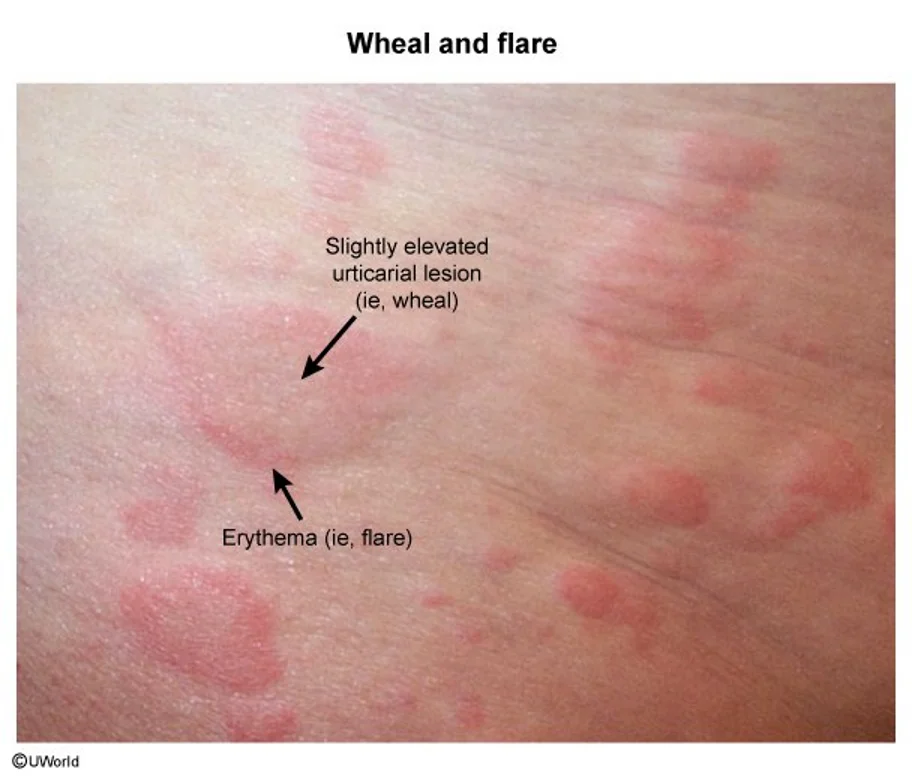
What this shows
Skin and mucosa (80 to 90 percent)
urticaria, flushing, pruritus, angioedema of lips, tongue and uvula; periorbital swelling, red eyes and tearing.Respiratory
wheeze, cough, hoarseness, stridor, hypoxemia.Cardiovascular
hypotension, tachycardia, syncope.Gastrointestinal
crampy pain, vomiting, diarrhea.Neurologic
a sense of impending doom.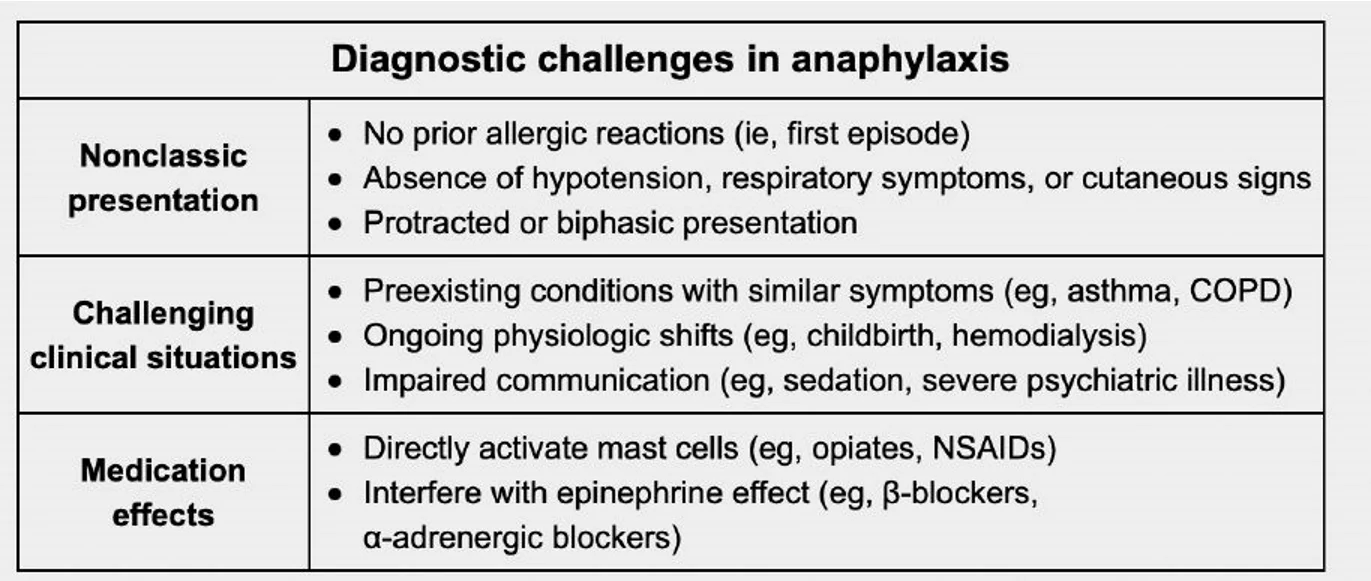
What this shows
Diagnosis (clinical, any one of three)
after rapid onset.- Skin plus one more: acute skin or mucosal involvement plus respiratory compromise or hypotension.
- Two systems: two or more systems (skin, respiratory, cardiovascular, persistent gastrointestinal) rapidly after a likely allergen.
- Hypotension alone: after a known allergen, even without skin findings.
No skin signs never excludes it
skin signs are absent in up to 20 percent.Serum tryptase
drawn 1 to 2 hours after onset, it supports the diagnosis retrospectively; it is never a reason to wait.| Anaphylaxis | Vasovagal reaction | Angioedema (ACE inhibitor or hereditary) | Asthma exacerbation | |
|---|---|---|---|---|
| Skin | Urticaria, flushing, pruritus | Pale, diaphoretic | Non-pitting swelling, no urticaria, no itch | None |
| Heart rate | Tachycardia | Bradycardia | Normal | Tachycardia |
| Airway | Stridor, wheeze, tongue swelling | Normal | Lip, tongue, laryngeal or bowel-wall swelling | Wheeze only |
| Response to epinephrine | Yes | Not needed | Poor (bradykinin-mediated): icatibant, C1-inhibitor, plasma | Partial |
Management
Intramuscular epinephrine immediately
0.3 to 0.5 mg (1 mg/mL) in the mid-anterolateral thigh (0.01 mg/kg in children, maximum 0.3 mg); repeat every 5 to 15 minutes if symptoms persist.- It is the first step in every case, from hives to shock, and has no absolute contraindication.
Auto-injectors
0.3 mg adult, 0.15 mg for 15 to 30 kg.Trigger and position
remove the trigger (stop the infusion, scrape out the stinger), supine with legs raised, high-flow oxygen, monitoring.- Sitting up if vomiting or in respiratory distress; sudden standing can cause empty-ventricle arrest.
Airway
progressive hoarseness, tongue or laryngeal edema, or stridor means intubate early, before the anatomy makes it impossible; cricothyrotomy if it does.Circulation
rapid isotonic crystalloid boluses (1 to 2 L; 20 mL/kg in children), because capillary leak can shift a third of the plasma volume.Refractory hypotension
after repeated intramuscular doses and fluids, a titrated intravenous epinephrine infusion in a monitored setting (boluses are avoided: dosing errors and arrhythmias).Patients on beta blockers
glucagon 1 to 5 mg intravenously when hypotension or bronchospasm does not respond (it bypasses the receptor; expect vomiting).| Therapy | Role | Trap |
|---|---|---|
| Intramuscular epinephrine | First line for airway edema, bronchospasm and shock | Never withheld because the pressure or skin is normal |
| Isotonic crystalloid | Replaces leaked volume | Needed with epinephrine in shock |
| Inhaled albuterol | Persistent bronchospasm | Does not treat edema or shock |
| H1 blocker, with or without an H2 blocker | Itch and hives | Slow; no effect on mortality |
| Glucocorticoid | Optional; may reduce protracted symptoms | Onset takes hours; never a substitute |
| Glucagon | Beta-blocked patient not responding to epinephrine | Protect the airway from vomiting |
| Intravenous epinephrine infusion | Refractory shock | Monitored and titrated, not a bolus |
Disposition and prevention
Observe at least 4 to 6 hours after resolution
longer (12 to 24 hours or admission) after hypotension, airway involvement, more than one epinephrine dose, asthma, beta blockade or poor access to care.- Protracted or severe reactions, and those needing several doses, carry the highest risk of a biphasic reaction, which can be fatal.
Biphasic reactions
recur in up to 20 percent within 1 to 72 hours (typically 8 to 10 hours).At discharge
two epinephrine auto-injectors with training, a written action plan, trigger avoidance, medical alert identification, and allergy referral for skin or IgE testing.Venom immunotherapy
after a systemic sting reaction it prevents 95 percent of recurrences.- It raises blocking immunoglobulin G (IgG) antibodies that stop the venom from reaching IgE on mast cells.
An essential culprit drug
consider desensitization.Minutes after a bee sting, a man on a beta blocker has hives, wheeze and a blood pressure of 70/40 that does not improve after two doses of intramuscular epinephrine and 2 L of saline. What is the next drug, and what does he need before discharge?
Anaphylactic shock blunted by beta blockade: give intravenous glucagon (protect the airway from vomiting), and a titrated epinephrine infusion if still refractory. Observe longer (biphasic risk); discharge with two epinephrine auto-injectors, an action plan, allergy referral and venom immunotherapy.
How it's tested
Minutes after a bee sting: hives, wheeze and BP 84/50: IM epinephrine 0.5 mg in the thigh now, then fluids and oxygen; antihistamines and steroids come after.
Hypotension and vomiting after peanut exposure with no rash: still anaphylaxis (criterion 3) — epinephrine; absent skin findings are the distractor.
Progressive hoarseness and tongue swelling despite two epinephrine doses: intubate early — the airway, not another antihistamine.
Persistent hypotension after three IM doses and 2 L of fluid in a patient on propranolol: glucagon plus a titrated IV epinephrine infusion.
Symptoms resolved in the ED — what is missing from "discharge home": observation for a biphasic reaction, two auto-injectors with teaching, an action plan, and allergy follow-up.
Go deeper
Guidelines: World Allergy Organization Anaphylaxis Guidance 2020
Related Step 2 pages: Approach to Shock, Distributive Shock, Approach to Fluid Replacement, Beta-Blocker Toxicity, Vasopressors & Inotropes
High-yield images2
Flashcards for this page
Card 1 of 5 · try-out only, nothing is saved
Management of anaphylaxis | |
Immediate management |
|
Adjunct management |
|
IM = intramuscular; IV = intravenous. |
You just read one page of 236
The rest of Step 2 CK, written exactly like this.
Rapid Review is the reading layer of a full Step 1 platform: a schedule fitted to your exam date, flashcards for every page, and a mentor a message away.
Every Step 1 system
Written the same way: what to know, how it’s tested, where to go deeper.
A plan built to your exam date
Tell us when you sit, and the schedule fits the whole library and your question bank to it.
Flashcards for every page
Ready-made spaced-repetition decks linked to each topic, so nothing you read gets forgotten.
