
Rapid Review·Cardiovascular
Select any text to highlight it or add a note.
Cardiovascular Pharmacology
T1Must knowAntiarrhythmic Drugs
Focus on
The Vaughan Williams classes and the one fact per drug the exam wants: procainamide for pre-excited AF and lupus; lidocaine for ischemic VT; flecainide only in a normal heart; sotalol and dofetilide prolong the QT; amiodarone hits the lungs, thyroid, liver, eyes and skin but is the safest in structural disease; verapamil never in HFrEF or pre-excited AF; adenosine for AVNRT; magnesium for torsades.
Key takeaways
How the classes work
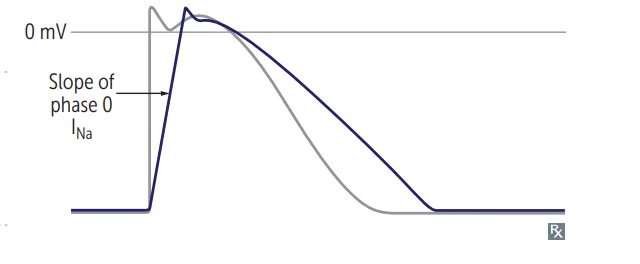
What this shows
Class I
blocks sodium channels (phase 0, slows conduction).Class II
blocks beta receptors (slows the nodes).Class III
blocks potassium channels (prolongs repolarization and the QT).Class IV
blocks nodal calcium channels (slows atrioventricular (AV) conduction).All are proarrhythmic
every one can also cause arrhythmias.Use dependence
class I drugs bind open sodium channels, so they act more at fast rates (IC more than IA more than IB) and widen the QRS at fast rates.Reverse use dependence
class III drugs prolong the QT more at slow rates, so the torsades risk is at rest and with bradycardia.On the electrocardiogram
classes IA and III prolong the QT; class IV prolongs the PR at fast rates.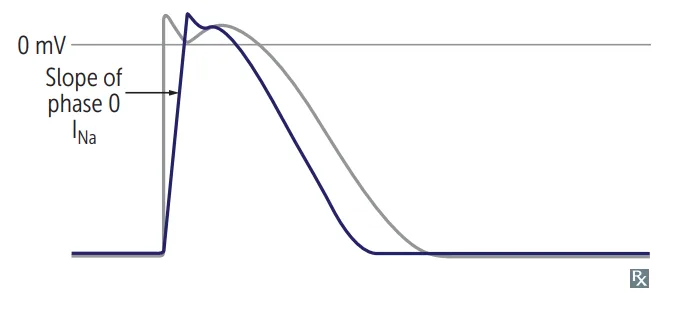
What this shows
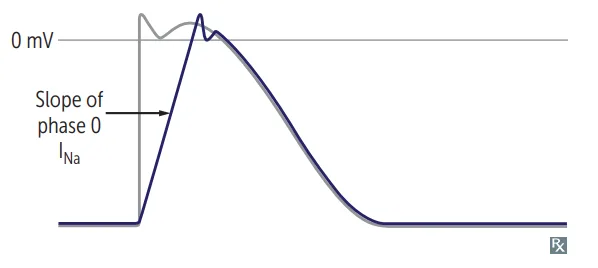
What this shows
The Vaughan Williams classes
| Class | Drugs | Indication | Side effects and traps |
|---|---|---|---|
| IA (sodium block) | Quinidine, procainamide, disopyramide | Ventricular and atrial arrhythmias; procainamide for pre-excited atrial fibrillation (Wolff-Parkinson-White Syndrome) | Long QT and torsades; anticholinergic effects; quinidine: cinchonism (tinnitus, confusion, psychosis); procainamide: drug-induced lupus; disopyramide: myocardial depression |
| IB (sodium block) | Lidocaine, mexiletine | Ventricular arrhythmias, especially in ischemia; digitalis-induced arrhythmias | Cardiovascular depression; central nervous system effects (tremor, agitation, seizures) |
| IC (sodium block) | Flecainide, propafenone | Atrial arrhythmias in a structurally normal heart | Ventricular arrhythmias; not used with structural heart disease or after infarction (increased mortality); can convert fibrillation to 1:1 flutter, so pair with an AV-nodal blocker |
| II (beta blockers) | Beta-1 selective "A to M" (atenolol, bisoprolol, esmolol, metoprolol); non-selective "N to Z" (propranolol); carvedilol and labetalol (alpha plus beta) | Atrial fibrillation and flutter, AV nodal reentry, angina, hypertension, heart failure; propranolol for migraine prophylaxis and thyrotoxicosis; nadolol for variceal prophylaxis; timolol for glaucoma | Fatigue, erectile dysfunction, depression, weight gain, impaired glucose tolerance, masked hypoglycemia; caution in acute heart failure, asthma; overdose: bradycardia, block, shock (fluids, atropine, glucagon; Beta-Blocker Toxicity) |
| III (potassium block) | Amiodarone, sotalol, dofetilide, ibutilide, dronedarone | Ventricular and atrial arrhythmias; amiodarone for arrhythmias with structural heart disease; ibutilide for acute conversion; dronedarone is contraindicated in heart failure and permanent fibrillation | Long QT and torsades (least with amiodarone); sotalol is also a beta blocker and renally cleared; amiodarone's multi-organ toxicity below |
| IV (non-dihydropyridine calcium block) | Diltiazem, verapamil | Atrial fibrillation and flutter, AV nodal reentry, angina, hypertension | Constipation, edema, bradyarrhythmias, hyperprolactinemia (verapamil); not in reduced-ejection-fraction heart failure (myocardial depression); not in pre-excited fibrillation |
| Other | Adenosine | Supraventricular tachycardia (AV Nodal Reentrant Tachycardia) | Transient block by potassium-channel activation; flushing, chest pain, sense of impending doom, bronchospasm; blunted by caffeine and theophylline |
| Other | Digoxin | Reduced-ejection-fraction heart failure, atrial fibrillation | Sodium-potassium pump inhibition raises calcium and contractility, and raises vagal tone; narrow window (Digoxin Toxicity) |
| Other | Atropine | Bradycardia | Muscarinic antagonist: dry mouth, constipation, urinary retention, confusion |
| Other | Magnesium | Torsades de pointes, digoxin arrhythmias | Flushing, hypotension |
| Other | Ivabradine | Reduced-ejection-fraction heart failure in sinus rhythm | Funny-channel block slows the sinus rate only; bradycardia, visual phosphenes |
Amiodarone toxicity
Cardiac
sinus bradycardia, heart block, QT prolongation (torsades risk).Pulmonary: chronic interstitial pneumonitis
the most common serious effect; cough, fever, dyspnea, infiltrates; stop the drug.Endocrine
hypothyroidism or hyperthyroidism.Hepatic
raised transaminases, hepatitis.Ocular
corneal microdeposits, optic neuropathy.Skin
blue-gray discoloration, photosensitivity.Neurologic
peripheral neuropathy.Interactions and monitoring
it raises digoxin (halve the dose) and warfarin levels; monitor thyroid and liver tests, a chest film and pulmonary function at baseline and periodically.| Disorder | Features | Treatment |
|---|---|---|
| Decreased T4 to T3 conversion | High T4, low T3, normal or mildly high thyroid-stimulating hormone (TSH) | None needed |
| Inhibition of hormone synthesis (hypothyroidism) | High TSH, low T4 | Levothyroxine; amiodarone may continue |
| Type 1 thyrotoxicosis (iodine-induced synthesis in an abnormal gland) | Low TSH, high T3 and T4, increased uptake and vascularity | Antithyroid drugs |
| Type 2 thyrotoxicosis (destructive thyroiditis) | Low TSH, high T3 and T4, undetectable uptake, decreased vascularity | Glucocorticoids |
Choosing a drug
Atrial fibrillation rhythm control
normal heart, flecainide or propafenone; coronary disease, sotalol or dofetilide; heart failure, amiodarone (Atrial Fibrillation).Stable monomorphic ventricular tachycardia
amiodarone, procainamide or lidocaine.Torsades
magnesium, never IA or III.Pre-excited fibrillation
procainamide or ibutilide, never AV-nodal blockers.Electrocardiographic signatures
class I (especially IC), a wide QRS at fast rates; classes IA and III, a long QT; classes II and IV, a long PR and sinus slowing; digoxin, a scooped ST segment with a short QT and long PR.A patient on long-term amiodarone develops a dry cough, dyspnea and bilateral infiltrates, and separately a low TSH with high T4 and an undetectable iodine uptake. What are the two problems and how is each treated?
Amiodarone pulmonary toxicity (chronic interstitial pneumonitis): stop the drug. Type 2 amiodarone thyrotoxicosis (destructive thyroiditis, undetectable uptake): glucocorticoids.
How it's tested
Stable AF in a 45-year-old with a structurally normal heart who wants rhythm control: flecainide (pill-in-the-pocket) with a beta blocker — never after an MI or with a low EF.
AF with rapid rates in a patient with EF 25%: amiodarone (or digoxin for rate) — not flecainide, not diltiazem.
Irregular wide-complex tachycardia at 240 in a young man with a delta wave on his baseline ECG: procainamide or cardioversion; adenosine, verapamil, beta blockers and digoxin can precipitate VF.
A woman on sotalol with a QTc of 560 has recurrent syncope: torsades — magnesium, stop sotalol, correct potassium; overdrive pacing if recurrent.
Two years on amiodarone: weight gain, fatigue, TSH 25: amiodarone hypothyroidism — levothyroxine; the amiodarone can usually continue.
Same patient with weight loss, palpitations, low TSH, no uptake on scan: type 2 amiodarone thyrotoxicosis — glucocorticoids.
Regular narrow tachycardia at 180 in a patient who just drank three coffees; adenosine does nothing: caffeine blocks adenosine — use a larger dose, or verapamil/diltiazem.
Go deeper
Guidelines: 2023 ACC/AHA/ACCP/HRS Atrial Fibrillation Guideline · 2017 AHA/ACC/HRS Ventricular Arrhythmias Guideline
Related Step 2 pages: Approach to Cardiac Drug Adverse Effects, Atrial Fibrillation, Ventricular Tachycardia, Torsades de Pointes, Wolff-Parkinson-White Syndrome, Digoxin Toxicity, Beta-Blocker Toxicity, Approach to Tachyarrhythmias
High-yield images3
You just read one page of 236
The rest of Step 2 CK, written exactly like this.
Rapid Review is the reading layer of a full Step 1 platform: a schedule fitted to your exam date, flashcards for every page, and a mentor a message away.
Every Step 1 system
Written the same way: what to know, how it’s tested, where to go deeper.
A plan built to your exam date
Tell us when you sit, and the schedule fits the whole library and your question bank to it.
Flashcards for every page
Ready-made spaced-repetition decks linked to each topic, so nothing you read gets forgotten.
