
Rapid Review·Cardiovascular
Select any text to highlight it or add a note.
Cardiovascular Pharmacology
T1Must knowDigoxin Toxicity
Focus on
An older patient on digoxin with nausea, anorexia, confusion and yellow-green halos, whose kidneys got worse or who was just started on amiodarone, verapamil or spironolactone — and an ECG with any arrhythmia, classically atrial tachycardia with block or bidirectional VT. Hypokalemia causes it; hyperkalemia in an acute overdose predicts death. Digoxin-specific antibody fragments reverse it.
Key takeaways
Mechanism and triggers
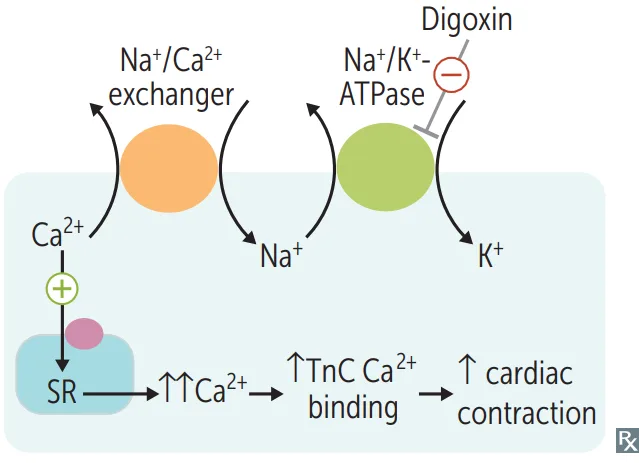
What this shows
Mechanism
digoxin inhibits the sodium-potassium pump, raising intracellular calcium (inotropy), and increases vagal tone (slows the sinus and atrioventricular (AV) nodes).A narrow window
it is renally excreted, and it competes with potassium for the pump, so hypokalemia potentiates it.Electrolyte triggers
hypokalemia (loop and thiazide diuretics, vomiting); hypomagnesemia.Clearance triggers
renal failure (reduced excretion), volume depletion from diuretics, hypothyroidism, advanced age.Drugs that raise digoxin levels
amiodarone, verapamil, quinidine, propafenone.- Reduce the digoxin dose by 25 to 50 percent when starting amiodarone, with weekly levels.
Spironolactone
predisposes by reducing renal clearance of digoxin, independent of its potassium effect.Clinical features
Gastrointestinal (earliest)
anorexia, nausea, vomiting, abdominal pain.Neurologic
fatigue, weakness, confusion, and altered color vision (yellow-green halos).Cardiac: any arrhythmia
frequent ventricular ectopy, bradycardia and AV block of every degree.- Atrial tachycardia with block: increased automaticity plus AV block is the signature.
- Bidirectional ventricular tachycardia: nearly pathognomonic.
Diagnosis
Serum digoxin level
drawn at least 6 hours after the last dose (earlier levels are falsely high).- Toxicity correlates poorly with the level in chronic disease, so treat the patient, not the number.
Potassium
though hypokalemia causes toxicity, hyperkalemia is seen in toxicity and predicts a poor prognosis (the blocked pump cannot move potassium into cells).- Also magnesium, renal function, thyroid function.
Electrocardiogram
toxicity gives inverted or biphasic T waves and a prolonged PR.- The therapeutic "digitalis effect" (scooped ST depression, a short QT) does not by itself mean toxicity.
| Chronic (the elderly on therapy) | Acute (overdose) | |
|---|---|---|
| Setting | Renal decline, dehydration, a new interacting drug | Intentional ingestion; a child with pills or plant glycosides |
| Potassium | Low (diuretics) or normal | High, the marker of severity |
| Symptoms | Insidious gut symptoms, confusion, visual change | Early vomiting, then arrhythmias over hours |
| Level | Mildly raised or "therapeutic" | Very high |
| Arrhythmias | Bradycardia, AV block, ectopy, atrial tachycardia with block | Bradyarrhythmias early, then ventricular arrhythmias |
Management and complications
First steps
stop digoxin, monitor continuously, correct hypokalemia and hypomagnesemia cautiously.Digoxin-specific antibody fragments (digoxin Fab)
reverse severe toxicity.- Indications: life-threatening arrhythmias, hemodynamic instability, hyperkalemia over 5 to 5.5 in acute toxicity, end-organ dysfunction, or a massive ingestion.
- After Fab, the measured total level rises (bound, inactive) and potassium falls.
Bradycardia or block
atropine; pacing only if Fab fails.Ventricular arrhythmias
Fab, lidocaine or phenytoin, magnesium.Hyperkalemia
Fab first, then insulin-glucose; avoid intravenous calcium (the exam still expects this).Decontamination
activated charcoal within 1 to 2 hours of an acute ingestion; dialysis does not remove digoxin (large volume of distribution).Prevention
dose by renal function and age, reduce the dose when starting amiodarone or verapamil, monitor potassium and creatinine.Complications
fatal ventricular arrhythmias, asystole, cardiogenic shock; hyperkalemic death in acute overdose; misdiagnosis as gastroenteritis or dementia in the elderly.An 82-year-old on digoxin and furosemide, recently started on amiodarone, has nausea, abdominal pain, yellow vision and a bidirectional ventricular tachycardia. What caused this, and what is the antidote?
Digoxin toxicity: amiodarone raised the digoxin level, and furosemide-induced hypokalemia potentiates it. Stop digoxin, correct potassium and magnesium, and give digoxin-specific antibody fragments (Fab) for the life-threatening arrhythmia.
How it's tested
An 82-year-old woman with AF and heart failure on digoxin and furosemide becomes nauseated and confused with yellow halos around lights; potassium is 3.1, creatinine has risen, and the ECG shows atrial tachycardia with 2:1 block: chronic digoxin toxicity — stop digoxin, replace potassium and magnesium, monitor; Fab if the arrhythmia is unstable.
A 3-year-old ate a bottle of his grandmother's digoxin; potassium is 6.2 with high-grade AV block: acute toxicity with hyperkalemia — digoxin-specific Fab immediately.
Which two drugs most classically precipitate digoxin toxicity when added: amiodarone and verapamil (also quinidine, spironolactone) — reduce the digoxin dose in advance.
Scooped ST segments with a short QT on the ECG of an asymptomatic patient with a therapeutic level: digitalis effect, not toxicity — no action.
Bidirectional ventricular tachycardia in a patient on digoxin: virtually diagnostic of digoxin toxicity — Fab.
Should this patient be dialyzed to remove digoxin: no — it is not dialyzable; Fab is the treatment.
Go deeper
Related Step 2 pages: Antiarrhythmic Drugs, Approach to Cardiac Drug Adverse Effects, Heart Failure, Atrial Fibrillation, Beta-Blocker Toxicity, Atrioventricular Block
High-yield images1
You just read one page of 236
The rest of Step 2 CK, written exactly like this.
Rapid Review is the reading layer of a full Step 1 platform: a schedule fitted to your exam date, flashcards for every page, and a mentor a message away.
Every Step 1 system
Written the same way: what to know, how it’s tested, where to go deeper.
A plan built to your exam date
Tell us when you sit, and the schedule fits the whole library and your question bank to it.
Flashcards for every page
Ready-made spaced-repetition decks linked to each topic, so nothing you read gets forgotten.
