
Rapid Review·Cardiovascular
Select any text to highlight it or add a note.
Cardiovascular Pharmacology
T1Must knowAntihypertensive Drugs
Focus on
Four first-line classes — thiazides, ACE inhibitors, ARBs and dihydropyridine CCBs — with the comorbidity choosing among them; beta blockers only when the heart needs them; and a second tier (MRAs, alpha blockers, central agonists, direct vasodilators) with distinctive side effects. Know each class's signature adverse effect and its pregnancy status.
Key takeaways
How the classes work
The equation
blood pressure is cardiac output times vascular resistance.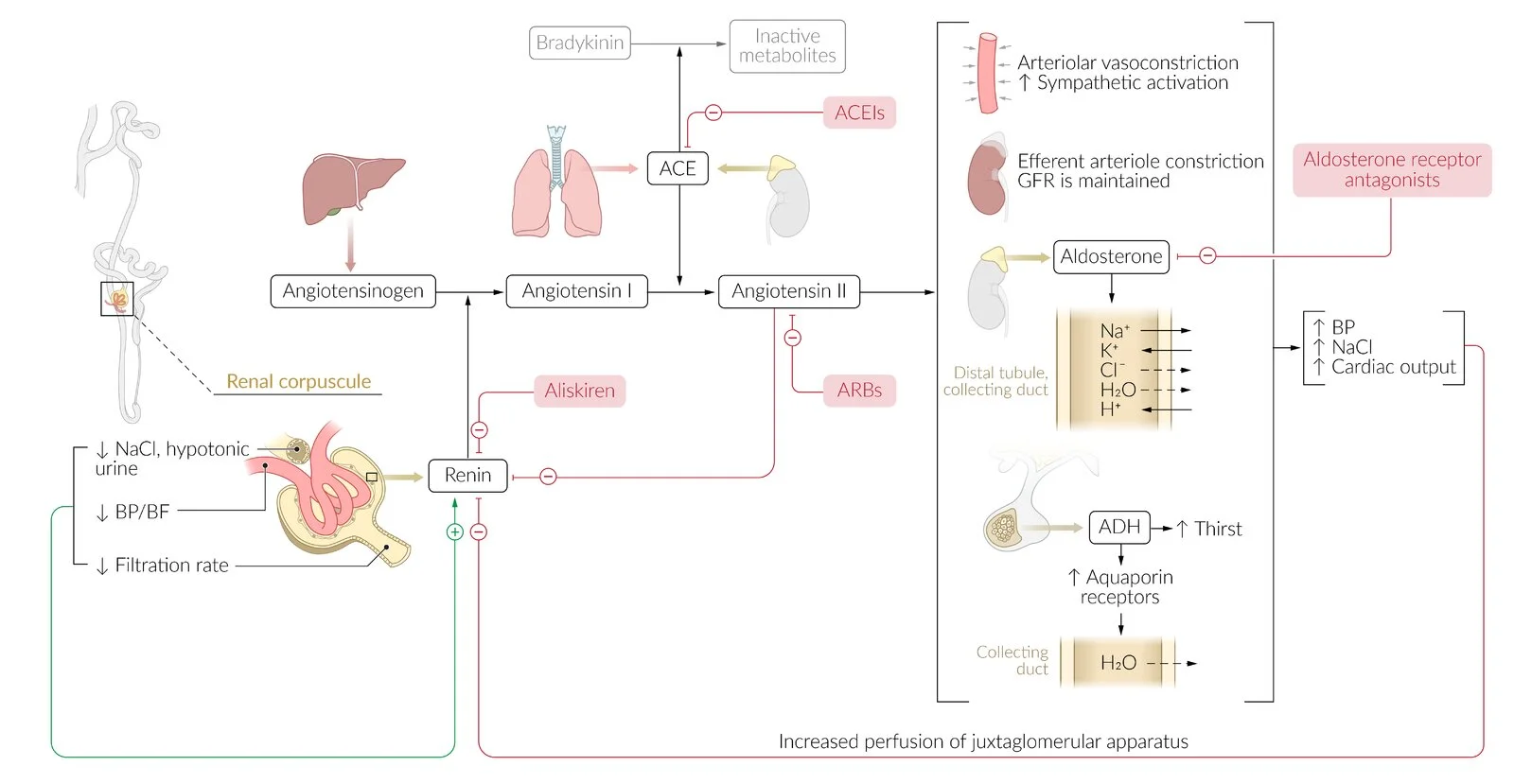
What this shows
Four strategies
the classes shed sodium (diuretics), block the renin-angiotensin-aldosterone axis, relax arterioles, or reduce sympathetic drive.Whom to treat and the targets
on Hypertension.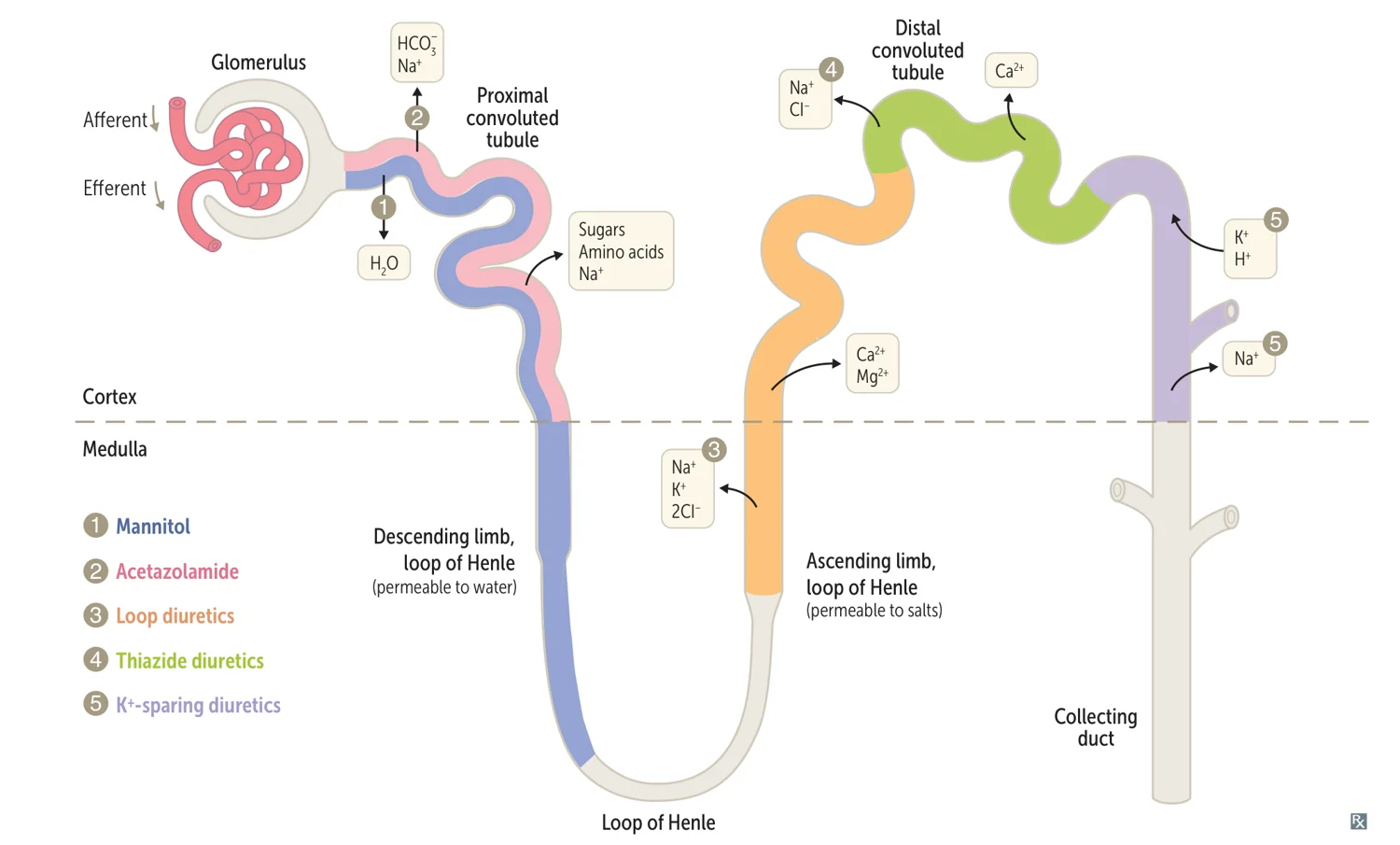
What this shows
Where the diuretics act
along the nephron.First-line classes
| Class | Drugs | Mechanism | Key adverse effects | Notes |
|---|---|---|---|---|
| Thiazide diuretics | Hydrochlorothiazide, chlorthalidone (preferred, longer acting), indapamide | Block the distal sodium-chloride cotransporter | Hypokalemia, hyponatremia, hypercalcemia, hyperuricemia (gout), hyperglycemia, erectile dysfunction | Best in Black patients and isolated systolic hypertension; useful in osteoporosis and calcium stones; avoid in gout; ineffective below a filtration rate of about 30 |
| Angiotensin-converting-enzyme (ACE) inhibitors | Lisinopril, enalapril, ramipril | Block angiotensin II formation; raise bradykinin | Dry cough, angioedema, hyperkalemia, an expected creatinine rise up to 30 percent, teratogenic | Nephroprotective in diabetes and kidney disease with albuminuria; post-infarction and heart failure; contraindicated in pregnancy, bilateral renal artery stenosis, prior angioedema; never with a receptor blocker |
| Angiotensin receptor blockers | Losartan, valsartan, candesartan | Block the angiotensin II type 1 (AT1) receptor | The same without the cough and with rare angioedema; hyperkalemia; teratogenic | Substitute for ACE-inhibitor intolerance; losartan is uricosuric (gout) |
| Dihydropyridine calcium-channel blockers | Amlodipine, nifedipine, nicardipine (intravenous) | Arteriolar L-type calcium-channel block | Peripheral edema (precapillary dilation, not volume; add an ACE inhibitor or switch), headache, flushing, constipation, gingival hyperplasia | Safe in heart failure, asthma, peripheral artery disease; Black patients; nifedipine in pregnancy |
Second-line and situational classes
| Class | Drugs | Adverse effects | When used |
|---|---|---|---|
| Beta blockers | Metoprolol, atenolol, bisoprolol (beta-1 selective, "A to M"); propranolol, nadolol (non-selective, "N to Z"); carvedilol, labetalol (alpha plus beta) | Fatigue, bradycardia, bronchospasm, masked hypoglycemia, erectile dysfunction, depression, weight gain, rebound on withdrawal | Not first line for uncomplicated hypertension; for coronary disease, heart failure, atrial fibrillation, thyrotoxicosis, migraine, portal hypertension; labetalol in pregnancy |
| Non-dihydropyridine calcium-channel blockers | Verapamil, diltiazem | Bradycardia, block, constipation, worsened heart failure, hyperprolactinemia (verapamil) | Rate control; not in reduced-ejection-fraction heart failure |
| Mineralocorticoid antagonists | Spironolactone, eplerenone | Hyperkalemia, gynecomastia (spironolactone; eplerenone spares) | Resistant hypertension (the fourth drug), primary aldosteronism, heart failure |
| Loop diuretics | Furosemide, torsemide | Hypokalemia, hypocalcemia, alkalosis, ototoxicity | Volume overload, kidney disease with a low filtration rate; not routine hypertension |
| Alpha-1 blockers | Prazosin, doxazosin | Postural hypotension, first-dose syncope, dizziness, headache | Not first line (limited outcome data); add-on with prostatic hyperplasia |
| Central alpha-2 agonists | Clonidine, methyldopa | Sedation, dry mouth; abrupt clonidine withdrawal causes rebound hypertensive urgency or emergency; methyldopa: Coombs-positive hemolytic anemia | Not first line; methyldopa in pregnancy |
| Direct vasodilators | Hydralazine, minoxidil, nitroprusside | Reflex tachycardia, fluid retention, headache; hydralazine: drug-induced lupus; minoxidil: hirsutism; nitroprusside: cyanide toxicity and methemoglobinemia | Hydralazine in pregnancy and with nitrates in heart failure; nitroprusside in hypertensive emergency |
Choosing and monitoring
Kidney disease or diabetes with albuminuria
an ACE inhibitor or receptor blocker.Coronary disease
a beta blocker plus an ACE inhibitor.Reduced-ejection-fraction heart failure
an ACE inhibitor or neprilysin combination, beta blocker, mineralocorticoid antagonist, sodium-glucose cotransporter-2 inhibitor.Atrial fibrillation
a beta blocker or non-dihydropyridine calcium-channel blocker.Gout
losartan or a calcium-channel blocker, no thiazide.Asthma
avoid non-selective beta blockers.Pregnancy
labetalol, nifedipine, methyldopa.Resistant hypertension
add spironolactone.Monitoring
a metabolic panel 1 to 2 weeks after starting or raising an ACE inhibitor, receptor blocker, mineralocorticoid antagonist or diuretic.- Accept a creatinine rise up to 30 percent (more suggests renal artery stenosis).
A 58-year-old with diabetes and albuminuria needs a blood pressure drug; after starting it her creatinine rises 20 percent and she develops a dry cough. Which class was it, is the creatinine rise acceptable, and what is the substitute?
An ACE inhibitor (the choice for diabetes with albuminuria). A creatinine rise up to 30 percent is expected. For the cough, switch to an angiotensin receptor blocker (no bradykinin build-up).
How it's tested
A 60-year-old with type 2 diabetes, hypertension and albuminuria: ACE inhibitor (or ARB) — renal protection beyond blood pressure.
Hypertensive man with gout: losartan (uricosuric) or a CCB; hydrochlorothiazide would provoke a flare.
Hypertensive woman with osteoporosis: a thiazide — it reduces urinary calcium loss.
A patient develops a dry cough on enalapril: switch to an ARB; if he had angioedema instead, avoid the whole RAAS-blocking family unless essential.
Creatinine rises 60% two weeks after starting lisinopril: stop it and image the renal arteries — bilateral renal artery stenosis.
Hypertension uncontrolled on chlorthalidone, amlodipine and lisinopril with good adherence: add spironolactone.
A pregnant woman at 12 weeks on lisinopril: stop it now — switch to labetalol or nifedipine.
Go deeper
Guidelines: 2025 ACC/AHA High Blood Pressure in Adults Guideline
Related Step 2 pages: Hypertension, Secondary Hypertension, Approach to Cardiac Drug Adverse Effects, Heart Failure, Beta-Blocker Toxicity, Orthostatic Hypotension
High-yield images2
You just read one page of 236
The rest of Step 2 CK, written exactly like this.
Rapid Review is the reading layer of a full Step 1 platform: a schedule fitted to your exam date, flashcards for every page, and a mentor a message away.
Every Step 1 system
Written the same way: what to know, how it’s tested, where to go deeper.
A plan built to your exam date
Tell us when you sit, and the schedule fits the whole library and your question bank to it.
Flashcards for every page
Ready-made spaced-repetition decks linked to each topic, so nothing you read gets forgotten.
