
Rapid Review·Cardiovascular
Select any text to highlight it or add a note.
Cardiovascular Pharmacology
T1Must knowAnticoagulants & Antiplatelets
Focus on
Antiplatelets for arteries (aspirin plus a P2Y12 inhibitor after ACS and stents), anticoagulants for the atrium, the veins and mechanical valves (DOACs for most, warfarin for mechanical valves and rheumatic mitral stenosis). Know each drug's mechanism, monitoring, reversal agent, and the two classic complications — heparin-induced thrombocytopenia and warfarin skin necrosis.
Key takeaways
The principle
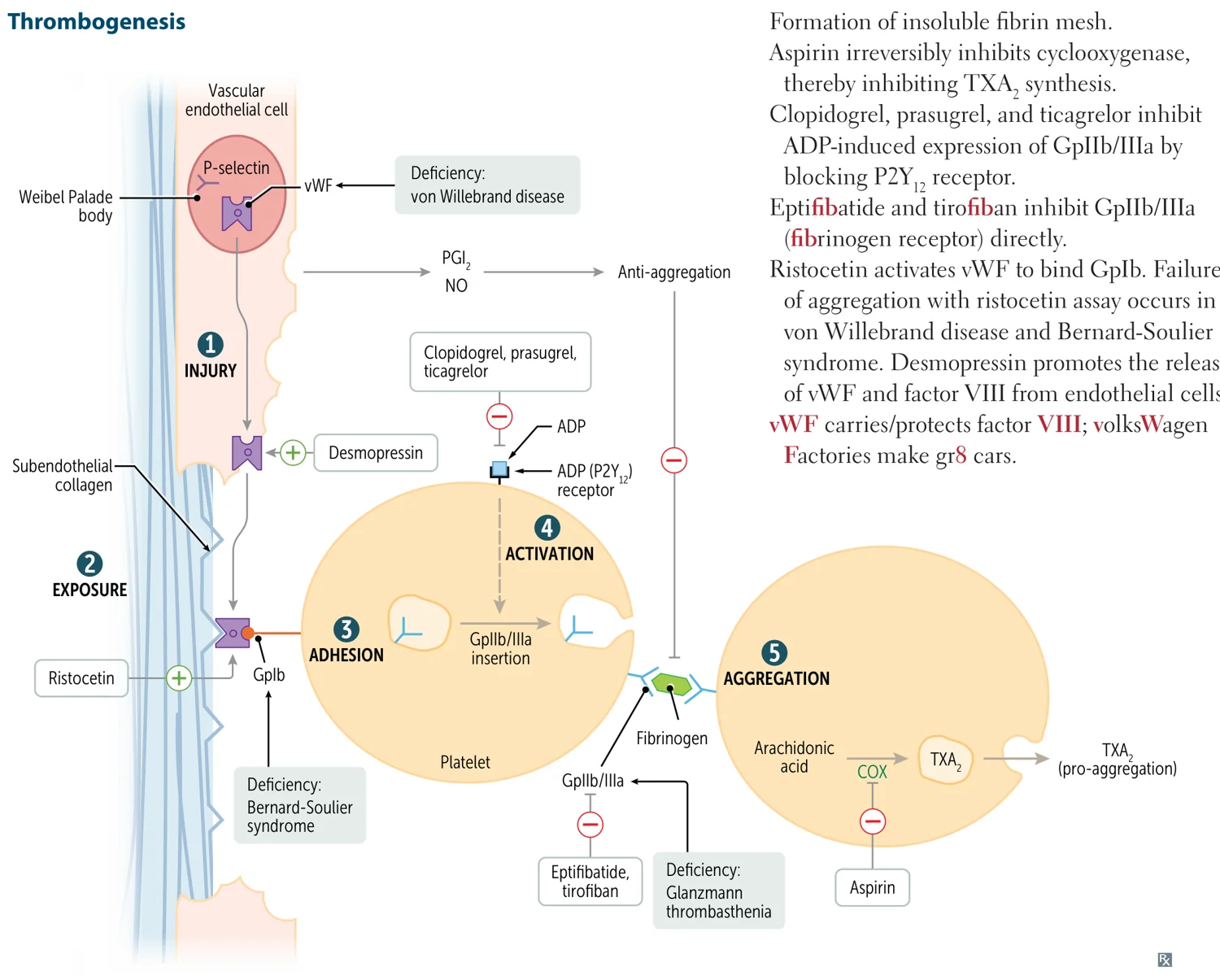
What this shows
Arterial thrombi are platelet-rich
from plaque rupture, so they are prevented with antiplatelets.Venous and atrial thrombi are fibrin-rich
from stasis, so they need anticoagulants.Mechanical valves
need warfarin.Antiplatelet agents
| Drug | Mechanism | Uses | Adverse effects and notes |
|---|---|---|---|
| Aspirin | Irreversible cyclooxygenase-1 inhibition, no thromboxane for the platelet's life (7 to 10 days) | Acute coronary syndrome (chew 162 to 325 mg), secondary prevention of all atherosclerotic disease, after stents and bypass, stroke, Kawasaki, pericarditis | Gastrointestinal bleeding and ulcers, bronchospasm in aspirin-exacerbated respiratory disease, Reye syndrome in children; ibuprofen taken first blocks its effect |
| P2Y12 inhibitors: clopidogrel, prasugrel, ticagrelor | Block the platelet adenosine diphosphate (ADP) receptor | Dual antiplatelet therapy with aspirin after acute coronary syndrome (12 months) and stents (6 to 12 months); clopidogrel alone for aspirin intolerance, stroke, peripheral artery disease | Clopidogrel: CYP2C19 poor responders, omeprazole interaction; prasugrel: contraindicated after stroke, over 75, under 60 kg; ticagrelor: dyspnea, bradyarrhythmias; hold 5 days (prasugrel 7) before surgery |
| Glycoprotein IIb/IIIa inhibitors: abciximab, eptifibatide, tirofiban | Block the final common pathway of aggregation | Bail-out during percutaneous intervention with large thrombus | Bleeding, thrombocytopenia |
| Dipyridamole, cilostazol | Phosphodiesterase inhibitors (raise cyclic AMP), vasodilation | Dipyridamole plus aspirin for stroke prevention; cilostazol for claudication | Headache, flushing; cilostazol is contraindicated in heart failure; dipyridamole potentiates adenosine |
Anticoagulants
| Drug | Mechanism | Monitoring | Reversal | Notes |
|---|---|---|---|---|
| Unfractionated heparin | Activates antithrombin; inhibits thrombin and factor Xa equally | Activated partial thromboplastin time; platelet count | Protamine (full) | Short half-life, safe in renal failure; the choice in percutaneous intervention, surgery, unstable patients, dialysis; heparin-induced thrombocytopenia (HIT) |
| Low-molecular-weight heparin: enoxaparin, dalteparin | Antithrombin-mediated, mostly anti-Xa | None routinely (anti-Xa in pregnancy, obesity, kidney disease) | Protamine (partial) | Subcutaneous, predictable; avoid if creatinine clearance under 30; less HIT; preferred in pregnancy and cancer thrombosis |
| Fondaparinux | Synthetic pentasaccharide, pure anti-Xa | None | None | No HIT (usable in HIT); avoid under a clearance of 30; not alone in percutaneous intervention (catheter thrombosis) |
| Direct thrombin inhibitors: argatroban, bivalirudin (intravenous); dabigatran (oral) | Bind thrombin directly | Argatroban: partial thromboplastin time (hepatic clearance) | Idarucizumab for dabigatran; dialysis removes dabigatran | Argatroban is the drug for HIT; dabigatran: dyspepsia, renally cleared, contraindicated in mechanical valves |
| Warfarin | Inhibits vitamin K epoxide reductase (factors II, VII, IX, X, proteins C and S) | International normalized ratio (INR) (2 to 3; 2.5 to 3.5 for a mechanical mitral valve) | Vitamin K; 4-factor prothrombin complex concentrate for life-threatening bleeding (plasma if unavailable) | Onset 3 to 5 days; protein C falls first, so transient hypercoagulability and skin necrosis in protein C deficiency (bridge with heparin); teratogenic; many CYP interactions (antibiotics, amiodarone, azoles raise the INR; rifampin, carbamazepine, vitamin K foods lower it); required for mechanical valves, rheumatic mitral stenosis, antiphospholipid syndrome |
| Factor Xa inhibitors: apixaban, rivaroxaban, edoxaban | Direct Xa inhibition | None | Andexanet alfa or prothrombin complex concentrate | Preferred for non-valvular atrial fibrillation and venous thromboembolism (fewer intracranial bleeds, no monitoring); renal adjustment (apixaban least renal); not for mechanical valves, rheumatic mitral stenosis, antiphospholipid syndrome, pregnancy |
| Fibrinolytics: alteplase, tenecteplase, streptokinase | Convert plasminogen to plasmin | Fibrinogen | Cryoprecipitate, tranexamic acid | ST-elevation infarction without timely intervention, massive pulmonary embolism, ischemic stroke under 4.5 hours; contraindicated with prior intracranial hemorrhage, stroke under 3 months, dissection, active bleeding, recent head trauma, uncontrolled hypertension |
Heparin-induced thrombocytopenia
Mechanism
antibodies against platelet factor 4-heparin complexes activate platelets.Picture
a platelet fall over 50 percent with paradoxical arterial and venous thrombosis, 5 to 10 days after heparin (earlier with prior exposure); more with unfractionated heparin.Diagnosis
the 4T score, then the platelet factor 4 assay and serotonin-release assay.Treatment
in order.- Stop all heparin: including flushes.
- Start argatroban: (or bivalirudin, fondaparinux).
- Warfarin only after platelets recover: then overlap at least 5 days.
Also
no platelet transfusions; anticoagulate 4 weeks (no thrombosis) to 3 months (thrombosis).Duration rules and the choice of anticoagulant
Dual antiplatelet therapy
12 months after an acute coronary syndrome, 6 months after an elective drug-eluting stent (3 if high bleeding risk), then aspirin for life (Acute Coronary Syndrome).Atrial fibrillation plus a stent
triple therapy for 1 to 4 weeks at most, then anticoagulant plus clopidogrel to 12 months, then the anticoagulant alone.Venous thromboembolism
provoked, 3 months; unprovoked or cancer, extended.Perioperative interruption
on Approach to Perioperative Cardiac Management.Warfarin
mechanical valves, moderate to severe rheumatic mitral stenosis, antiphospholipid syndrome, dialysis, left ventricular thrombus (traditionally).A direct oral anticoagulant
everything else (non-valvular atrial fibrillation, venous thromboembolism, cancer thrombosis except gut or urinary tumors, where low-molecular-weight heparin is preferred).Seven days into unfractionated heparin after surgery, a patient's platelets fall from 250,000 to 90,000 and he develops a new deep vein thrombosis. What is the diagnosis, what is stopped, and what is started?
Heparin-induced thrombocytopenia (over 50 percent fall with paradoxical thrombosis at 5 to 10 days). Stop all heparin, including flushes; start argatroban (or bivalirudin, fondaparinux); no platelet transfusion; warfarin only after the platelets recover, with a 5-day overlap.
How it's tested
NSTEMI treated with a drug-eluting stent — antiplatelet plan: aspirin plus ticagrelor (or prasugrel) for 12 months, then aspirin alone for life.
Platelets fall from 250 to 90 on day 7 of heparin after hip surgery, with a new DVT: heparin-induced thrombocytopenia — stop all heparin, start argatroban; no warfarin until the count recovers.
A woman with protein C deficiency starts warfarin without heparin and develops painful purple skin lesions on her thighs on day 4: warfarin-induced skin necrosis — protein C falls before the procoagulant factors; stop warfarin, heparin, vitamin K, protein C concentrate.
Life-threatening GI bleed on apixaban: stop it, give andexanet alfa (or 4-factor PCC), resuscitate.
INR 9 with a brain hemorrhage on warfarin: IV vitamin K plus 4-factor PCC.
Which anticoagulant for AF with a mechanical mitral valve: warfarin, INR 2.5–3.5 — never a DOAC.
Pregnant woman with a DVT: LMWH throughout pregnancy — warfarin is teratogenic, DOACs are not studied.
Go deeper
Guidelines: [2021 CHEST Antithrombotic Therapy for VTE Guideline](https://journal.chestnet.org/article/S0012-3692(21)01506-3/fulltext) · 2025 ACC/AHA Acute Coronary Syndromes Guideline
Related Step 2 pages: Approach to Cardiac Drug Adverse Effects, Acute Coronary Syndrome, Atrial Fibrillation, Prosthetic Heart Valves, Approach to Perioperative Cardiac Management
High-yield images1
You just read one page of 236
The rest of Step 2 CK, written exactly like this.
Rapid Review is the reading layer of a full Step 1 platform: a schedule fitted to your exam date, flashcards for every page, and a mentor a message away.
Every Step 1 system
Written the same way: what to know, how it’s tested, where to go deeper.
A plan built to your exam date
Tell us when you sit, and the schedule fits the whole library and your question bank to it.
Flashcards for every page
Ready-made spaced-repetition decks linked to each topic, so nothing you read gets forgotten.
