
Rapid Review·Cardiovascular
Select any text to highlight it or add a note.
Cardiovascular Pharmacology
T1Must knowLipid-Lowering Therapy
Focus on
Statins first and hardest — know high- from moderate-intensity by dose, the muscle and liver effects, and the interactions. Then the add-ons when LDL is still above 70: ezetimibe, PCSK9 inhibitors, bempedoic acid. Fibrates and omega-3s are for triglycerides above 500; niacin and bile-acid sequestrants are mostly about their side effects.
Key takeaways
Overview
The principle
lowering low-density lipoprotein (LDL) prevents events in proportion to the fall.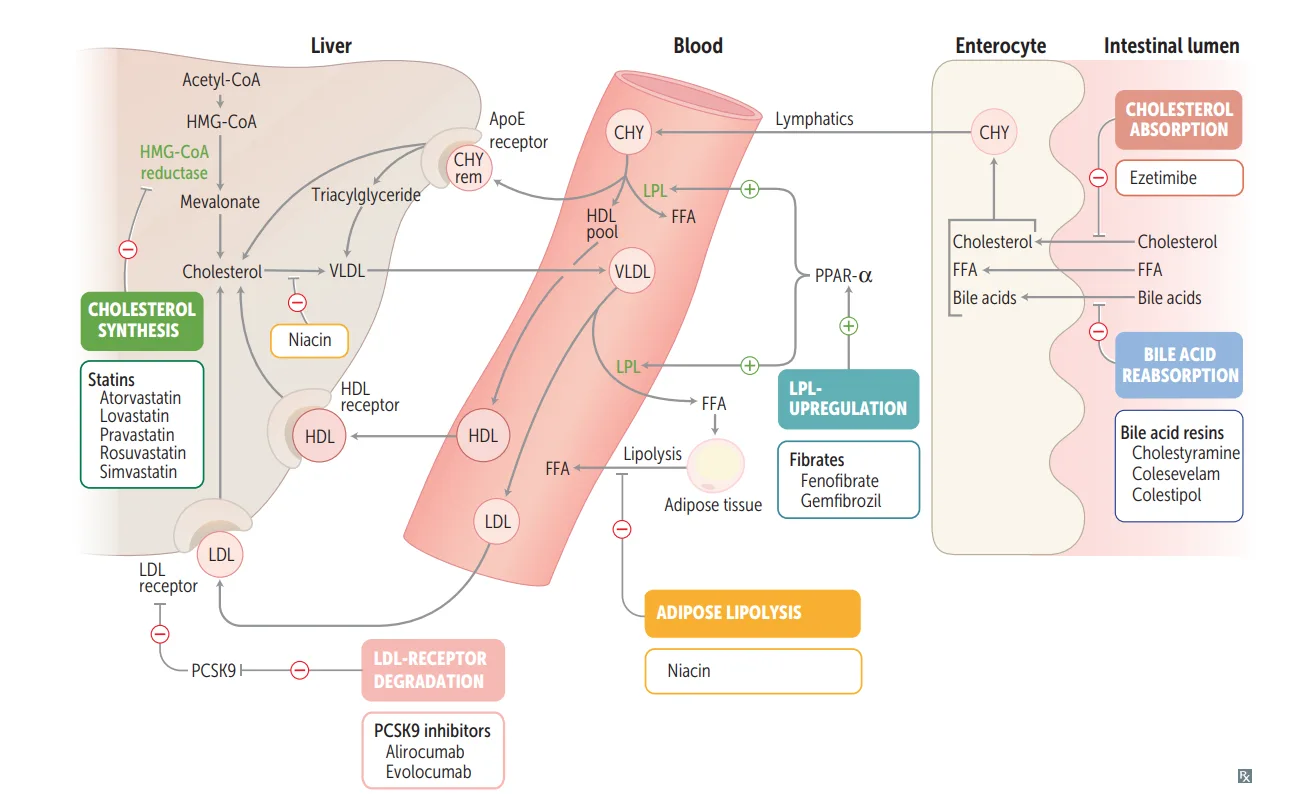
What this shows
Who does what
statins have the outcome data, the non-statin LDL drugs add on top, and triglyceride drugs mainly prevent pancreatitis.Who gets treated
on Hyperlipidemia; this page is the drugs.Statins
| Intensity | Expected LDL fall | Drugs and daily doses |
|---|---|---|
| High | 50 percent or more | Atorvastatin 40 to 80 mg, rosuvastatin 20 to 40 mg |
| Moderate | 30 to 49 percent | Atorvastatin 10 to 20, rosuvastatin 5 to 10, simvastatin 20 to 40, pravastatin 40 to 80 |
| Low | Under 30 percent | Simvastatin 10, pravastatin 10 to 20 |
Mechanism
competitive inhibition of HMG-CoA reductase, with pleiotropic plaque stabilization and antioxidant effects (the reason for early high-dose statins in acute coronary syndrome).- LDL and triglycerides fall, high-density lipoprotein (HDL) rises.
Adverse effects
myalgia, statin-associated myopathy, myositis and rhabdomyolysis (dark urine, kidney injury), raised liver enzymes and hepatotoxicity (stop only if over 3 times normal), a small rise in new-onset diabetes.Interactions
CYP3A4 inhibitors (azoles, macrolides, protease inhibitors, amiodarone, diltiazem, grapefruit) raise simvastatin, lovastatin and atorvastatin levels.- Pravastatin and rosuvastatin are not CYP3A4-dependent.
Contraindications
pregnancy and breastfeeding, and active liver disease.Muscle symptoms
hold, check creatine kinase and thyroid function, then rechallenge at a lower dose or with a different statin.Non-statin lipid drugs
| Class | Drugs | Mechanism | Lipid effect | Adverse effects and notes |
|---|---|---|---|---|
| Cholesterol absorption inhibitor | Ezetimibe | Blocks cholesterol absorption at the enterocyte | LDL down 15 to 20 percent (additive to statins) | Diarrhea; contraindicated in active liver disease; cholestyramine reduces its absorption; the first add-on when LDL stays high |
| PCSK9 inhibitors | Evolocumab, alirocumab (injected antibodies) | Prevent LDL-receptor degradation | LDL down 50 to 60 percent on top of a statin | Injection-site reactions, rarely delirium; for atherosclerotic disease or familial hypercholesterolemia not at goal on statin plus ezetimibe |
| Bile acid sequestrants | Cholestyramine, colestipol | Bind bile acids in the gut and interrupt the enterohepatic circulation | LDL down; HDL up slightly; triglycerides up | Nausea, bloating, cramping, bowel obstruction, gallstones; impaired absorption of warfarin, digoxin and fat-soluble vitamins; contraindicated with triglycerides over 300 to 500; the safe choice in pregnancy |
| Fibrates | Fenofibrate, gemfibrozil, bezafibrate | Activate peroxisome proliferator-activated receptor (PPAR) alpha | Triglycerides down, HDL up | Dyspepsia, myopathy (worse with statins), cholelithiasis (reduced 7-alpha-hydroxylase), potentiate warfarin and sulfonylureas; contraindicated in renal insufficiency and liver failure; indicated only for triglycerides over 500 |
| Niacin | Niacin | Inhibits lipolysis and free fatty acid release | LDL down, HDL up (the most), triglycerides down | Flushing (treat with aspirin or non-steroidal drugs) and pruritus, hyperglycemia, hyperuricemia and gout, liver failure; contraindicated in gout and diabetes; alcohol worsens the liver damage and flushing |
| Omega-3 fatty acids | Icosapent ethyl, eicosapentaenoic acid (EPA) and docosahexaenoic acid (DHA) | Reduce hepatic triglyceride synthesis and secretion | Triglycerides down | Fishy taste, nausea; no severe interactions |
| Microsomal triglyceride transfer protein inhibitor | Lomitapide | Blocks very-low-density lipoprotein (VLDL) and chylomicron assembly | VLDL and LDL down | Gastrointestinal symptoms, liver toxicity; contraindicated in pregnancy and hepatic impairment; raises warfarin levels; homozygous familial hypercholesterolemia only |
The sequence and monitoring
In atherosclerotic disease
step up in order.- A maximally tolerated high-intensity statin: recheck at 4 to 12 weeks.
- Add ezetimibe: if LDL is still above goal (70, or 55 at very high risk).
- Add a PCSK9 inhibitor: if still above goal.
Triglycerides of 500 or more
address secondary causes, then a fibrate or omega-3 (pancreatitis prevention).Pregnancy
stop statins and ezetimibe; a bile acid sequestrant if needed.Monitoring
a lipid panel 4 to 12 weeks after any change, then every 3 to 12 months; baseline liver enzymes; creatine kinase only for muscle symptoms; uric acid with niacin.A man with a prior infarction has an LDL of 95 on atorvastatin 80 mg for 3 months. What is the next drug, and what comes after that if he is still above goal?
Add ezetimibe (LDL goal under 70, or 55 at very high risk); if still above goal, add a PCSK9 inhibitor (evolocumab or alirocumab).
How it's tested
Post-MI patient started on atorvastatin 80 mg; LDL 95 at 8 weeks: add ezetimibe; if still ≥ 70, a PCSK9 inhibitor.
Diffuse myalgias and a CK of 12× normal on simvastatin 40 mg after starting clarithromycin: statin myopathy from a CYP3A4 interaction — stop both, hydrate, recheck; later rechallenge with pravastatin or rosuvastatin.
Statin-intolerant patient offered a lipid-lowering drug develops a gout flare and a raised creatinine: bempedoic acid.
A woman with hypercholesterolemia planning pregnancy: stop the statin; a bile-acid sequestrant is the option during pregnancy.
Triglycerides of 900 with a history of pancreatitis, on a statin: add fenofibrate (not gemfibrozil with the statin) or omega-3, alcohol abstinence.
Patient stopped his lipid drug because of intense facial flushing: niacin — pretreat with aspirin or switch to a statin.
A patient on cholestyramine has a rising INR fluctuation and low vitamin D: sequestrant binding warfarin and fat-soluble vitamins — separate the doses by 4 hours.
Go deeper
Guidelines: 2026 ACC/AHA Multisociety Guideline on the Management of Dyslipidemia
Related Step 2 pages: Hyperlipidemia, Genetic Dyslipidemias, Approach to Cardiac Drug Adverse Effects, Stable Angina, Acute Coronary Syndrome
High-yield images1
You just read one page of 236
The rest of Step 2 CK, written exactly like this.
Rapid Review is the reading layer of a full Step 1 platform: a schedule fitted to your exam date, flashcards for every page, and a mentor a message away.
Every Step 1 system
Written the same way: what to know, how it’s tested, where to go deeper.
A plan built to your exam date
Tell us when you sit, and the schedule fits the whole library and your question bank to it.
Flashcards for every page
Ready-made spaced-repetition decks linked to each topic, so nothing you read gets forgotten.
