
Rapid Review·Cardiovascular
Select any text to highlight it or add a note.
Vascular: Peripheral
T2High yieldLeriche Syndrome
Focus on
The triad of bilateral buttock and thigh claudication, erectile dysfunction and absent femoral pulses — atherosclerosis at the aortic bifurcation. Impotence is almost universal in men; if it is missing, look for another diagnosis. CT angiography, risk-factor control, and aortobifemoral bypass or iliac stenting.
Key takeaways
What it is and who gets it
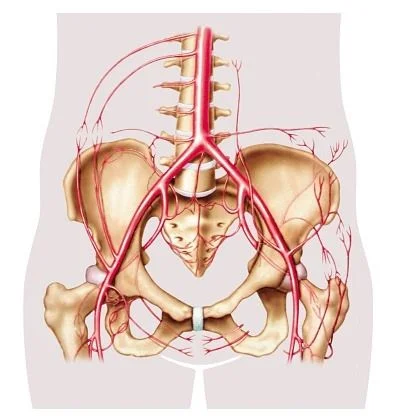
What this shows
Leriche syndrome
chronic atherosclerotic obstruction of the aortoiliac vessels at the bifurcation of the aorta into the common iliac arteries.Collaterals save the limb
because the block is proximal, the whole lower body is under-perfused, but slow progression allows collaterals, so limb loss is uncommon.Risk factors
atherosclerotic disease with smoking dominant; typically men 40 to 60, younger than femoropopliteal disease.Clinical features and diagnosis
The triad
three features.- Bilateral claudication: of the thighs, quadriceps and buttocks.
- Erectile dysfunction: the most sensitive feature.
- Absent or diminished femoral pulses: and therefore every pulse below, often with symmetric atrophy of both legs from chronic ischemia, and an aortic or iliac bruit.
Ankle-brachial index
reduced bilaterally; the femoral pulse examination localizes the level.Computed tomography (CT) angiography (or magnetic resonance (MR) angiography)
defines the aortic and iliac extent and the distal run-off for planning; assess the coronaries, carotids and abdominal aorta too.| Level | Claudication | Pulses absent from | Other clue |
|---|---|---|---|
| Aortoiliac (Leriche) | Buttock, hip, thigh (bilateral) | Femoral downward | Erectile dysfunction, aortic or iliac bruit, symmetric atrophy |
| Femoropopliteal | Calf | Popliteal downward | The most common level; femoral pulse present |
| Tibial or peroneal | Foot; forefoot rest pain | Pedal only | Diabetes, the elderly; ulcers and gangrene |
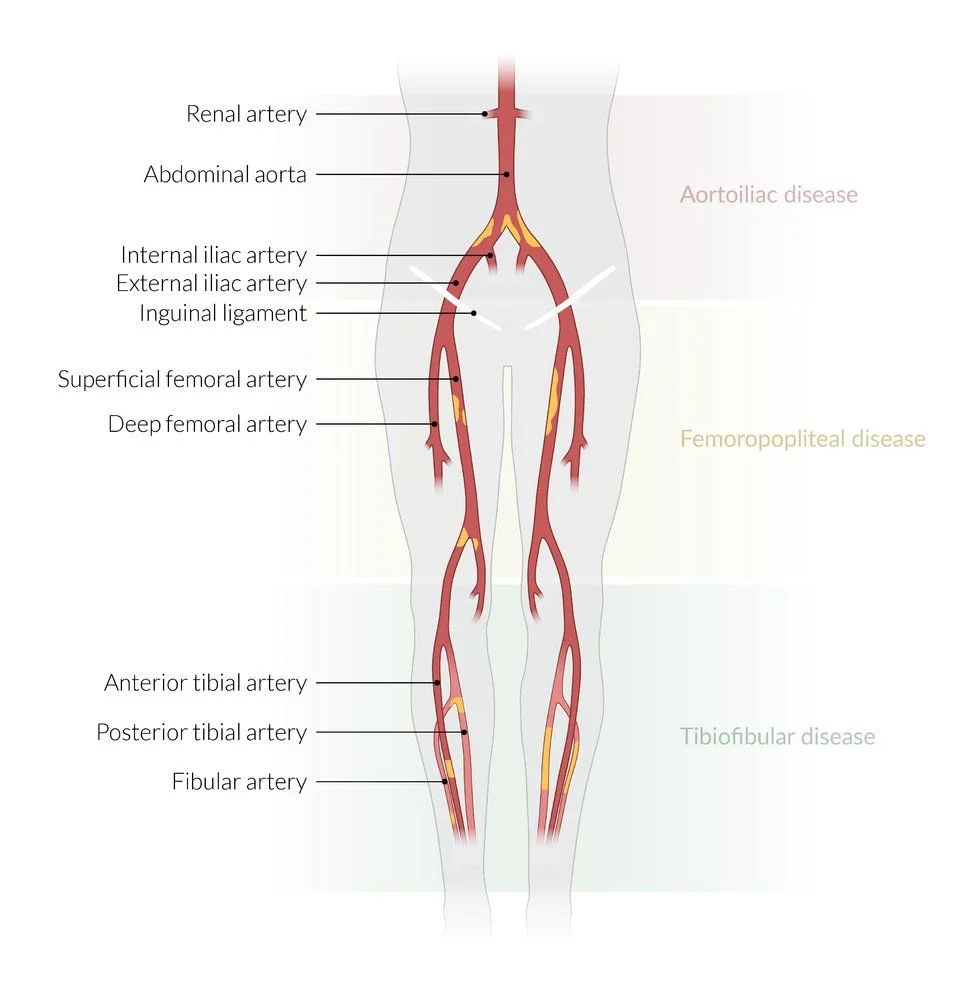
What this shows
Management and complications
Everything that applies to Peripheral Artery Disease
smoking cessation, antiplatelet, statin, blood pressure and glucose control, supervised exercise, cilostazol for symptoms.Revascularization
for lifestyle-limiting claudication or limb-threatening ischemia; aortoiliac disease responds best.- Angioplasty and stenting for focal iliac lesions.
- Aortobifemoral bypass (durable) for long or bilateral occlusions.
- Axillobifemoral bypass in high-risk patients.
Complications
critical limb ischemia once distal disease is added, acute thrombosis of the occluded segment (the saddle embolus is the acute version; Acute Limb Ischemia).- After aortobifemoral bypass: graft infection, aortoenteric fistula, impaired ejaculation from autonomic nerve injury.
A 52-year-old smoker has cramping in both buttocks and thighs on walking, erectile dysfunction, and weak femoral pulses with wasted legs. What is the level of disease, and what is the durable operation for a long occlusion?
Aortoiliac occlusion (Leriche syndrome): bilateral buttock and thigh claudication, impotence and absent femoral pulses. After risk-factor control, aortobifemoral bypass is durable for long or bilateral occlusions; stenting for focal iliac lesions.
How it's tested
A 55-year-old smoker with bilateral buttock and thigh pain after walking one block, inability to maintain an erection, and absent femoral pulses: Leriche syndrome — ABI and CT angiography; risk-factor therapy, then aortobifemoral bypass or iliac stenting.
Same complaints with normal femoral pulses and normal erectile function: think spinal stenosis or hip osteoarthritis — impotence is almost always present in true aortoiliac disease.
Which vessel's compromise causes the impotence: the internal iliac (hypogastric) → internal pudendal arteries.
Sudden bilateral leg pain, pallor and paralysis in a patient with atrial fibrillation: acute saddle embolus at the bifurcation, not chronic Leriche — heparin and embolectomy now.
Go deeper
Guidelines: 2024 ACC/AHA Peripheral Artery Disease Guideline
Related Step 2 pages: Peripheral Artery Disease, Acute Limb Ischemia, Approach to Leg Pain & Ulcers, Abdominal Aortic Aneurysm, Approach to Aortic Syndromes
High-yield images2
Flashcards for this page
Card 1 of 1 · try-out only, nothing is saved
You just read one page of 236
The rest of Step 2 CK, written exactly like this.
Rapid Review is the reading layer of a full Step 1 platform: a schedule fitted to your exam date, flashcards for every page, and a mentor a message away.
Every Step 1 system
Written the same way: what to know, how it’s tested, where to go deeper.
A plan built to your exam date
Tell us when you sit, and the schedule fits the whole library and your question bank to it.
Flashcards for every page
Ready-made spaced-repetition decks linked to each topic, so nothing you read gets forgotten.
