
Rapid Review·Cardiovascular
Select any text to highlight it or add a note.
Vascular: Peripheral
T1Must knowPeripheral Artery Disease
Focus on
Claudication is coronary disease in the legs: the patient is more likely to die of MI or stroke than to lose the limb. Ankle-brachial index ≤ 0.9 makes the diagnosis; smoking cessation, aspirin and a statin change survival; supervised exercise is the first treatment for symptoms, cilostazol second, revascularization for lifestyle-limiting claudication or limb-threatening ischemia.
Key takeaways
What it is and who gets it
Peripheral artery disease (PAD)
atherosclerosis of the peripheral vessels, primarily the lower extremities.A coronary equivalent
a 20 percent 5-year risk of infarction or stroke and 15 to 30 percent cardiovascular death, far above the risk of limb loss.Risk factors
smoking (the strongest), hypertension, hyperlipidemia, diabetes, chronic kidney disease, established coronary disease.Clinical features
Intermittent claudication is the initial symptom
muscle pain induced by walking and relieved by rest, in the quadriceps, calves or gluteal muscles.- The level names the vessel: buttock and thigh, aortoiliac (Leriche Syndrome); calf, femoropopliteal (the most common); foot, tibial.
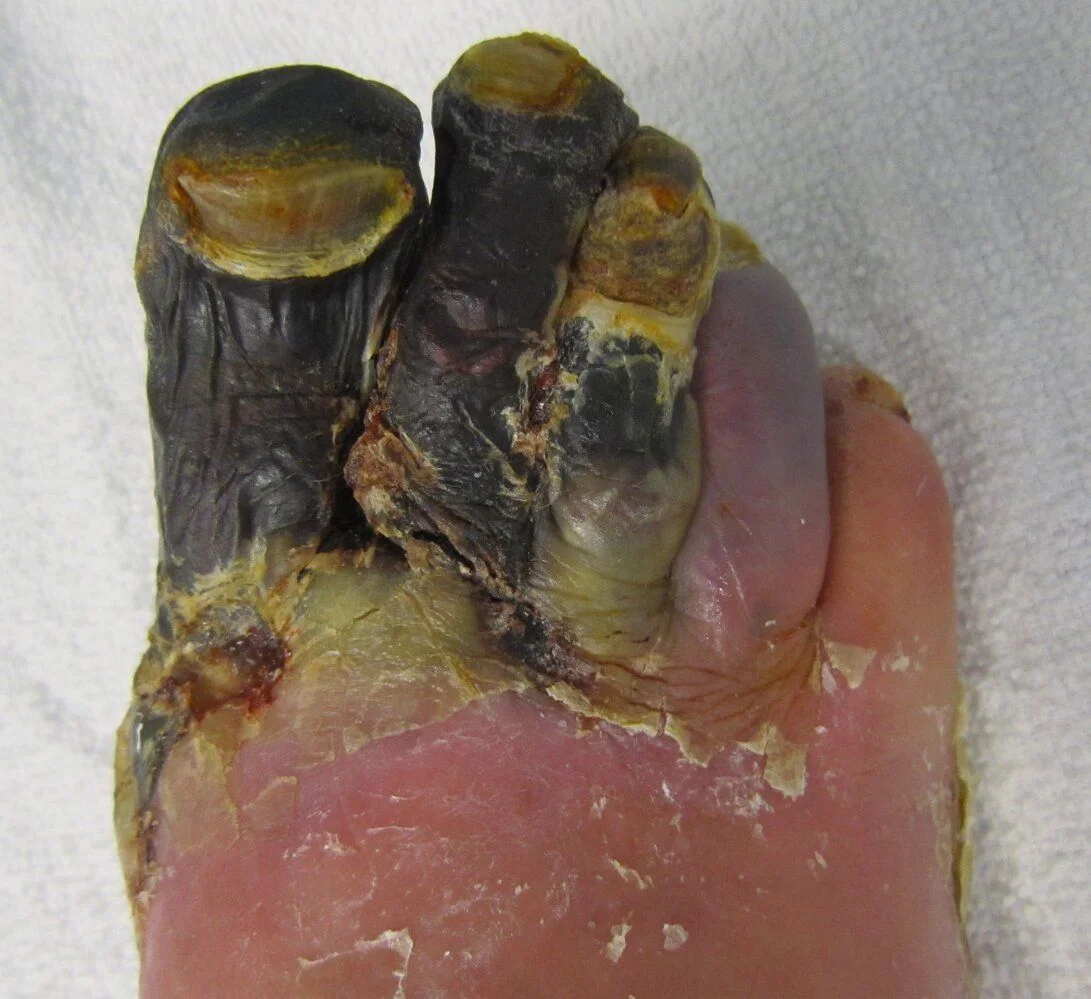
What this shows
Severe disease (chronic limb-threatening ischemia)
ischemic rest pain in the forefoot, worse at night and relieved by dangling the foot, limb cyanosis, shiny hairless skin, distal ulcers, muscle atrophy, gangrene.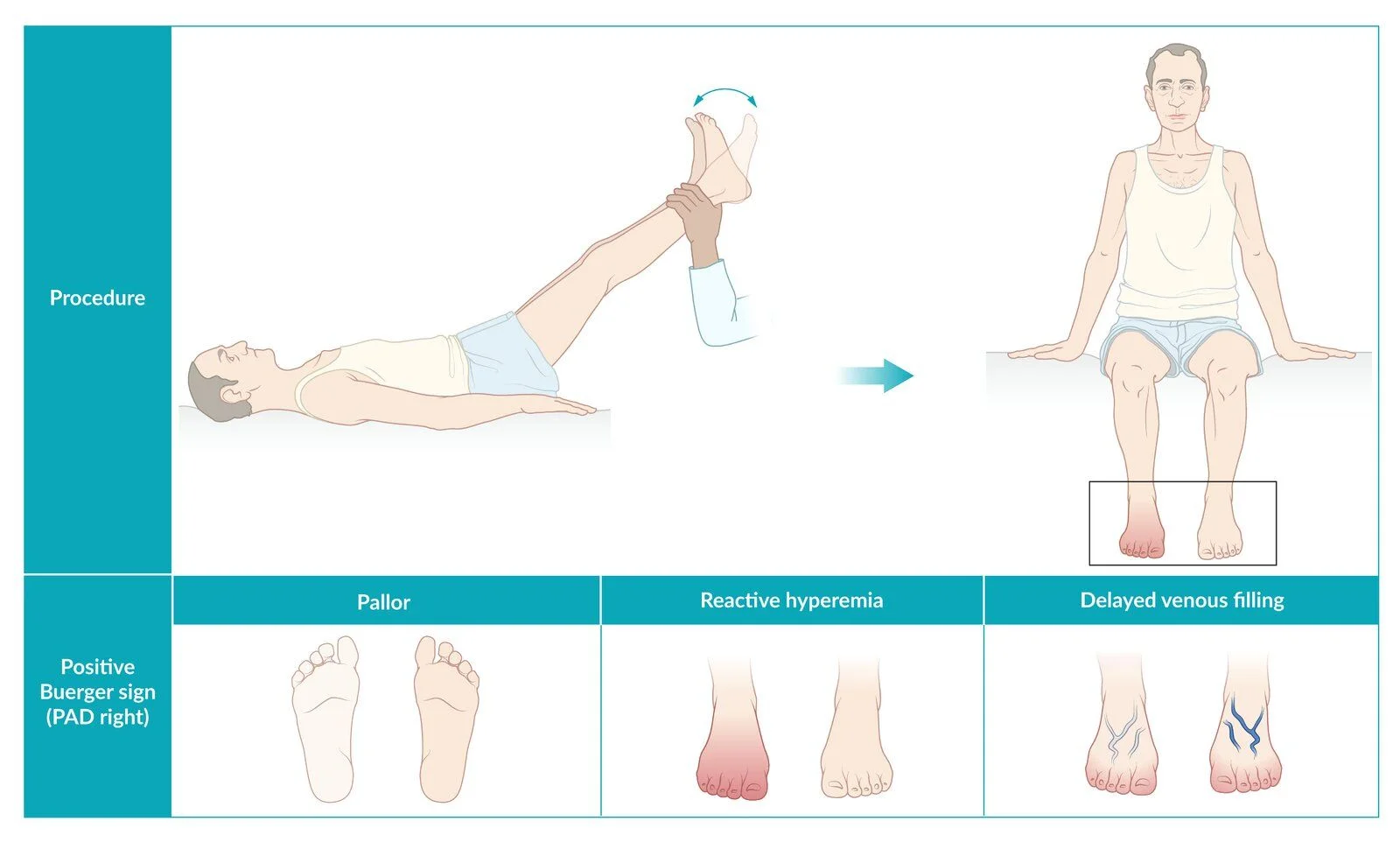
What this shows
Buerger sign
the elevated foot turns pale, then bright red when lowered (dependent rubor).Diagnosis
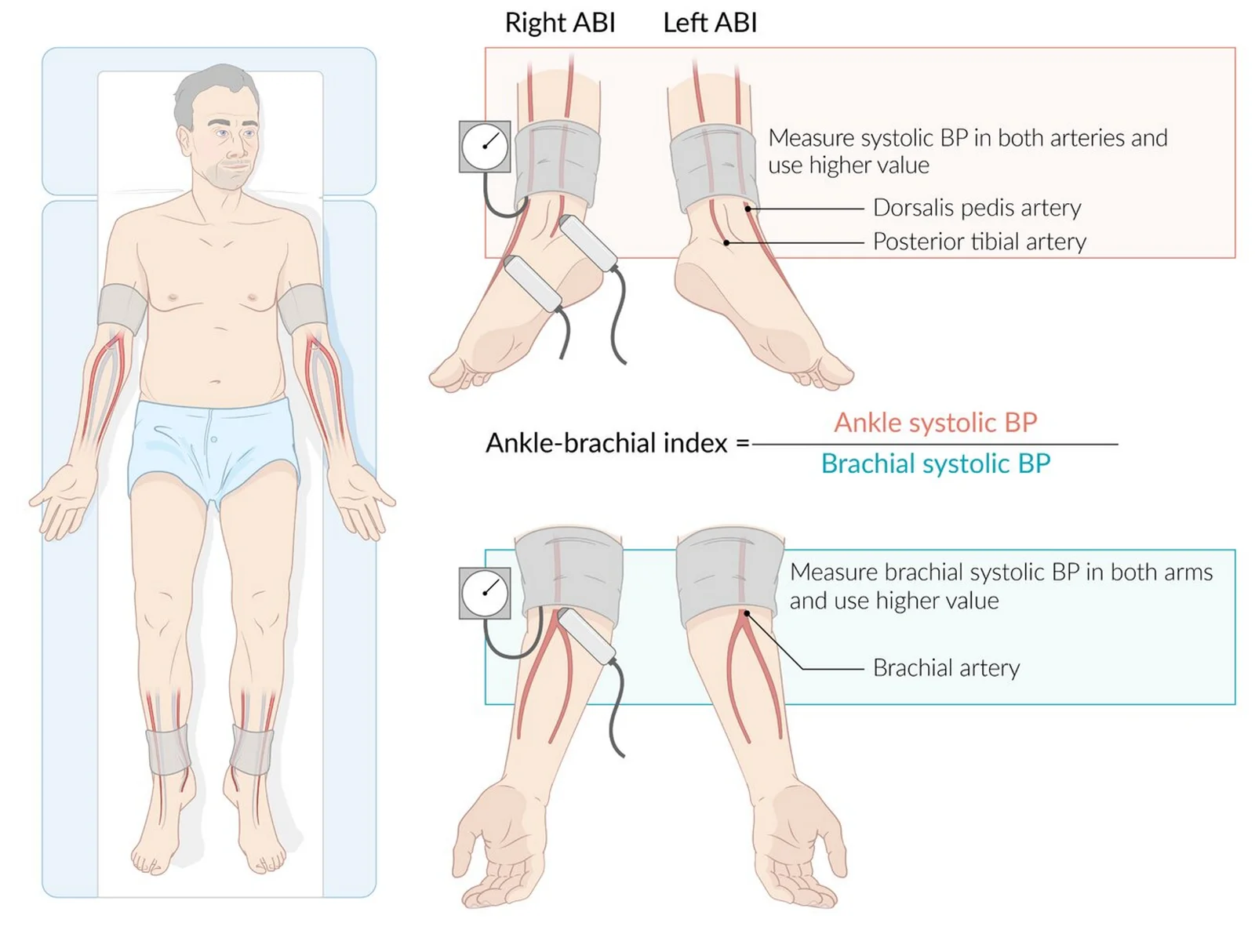
What this shows
Ankle-brachial index (ABI) is the first test
the higher ankle systolic pressure divided by the higher brachial pressure.- Add exercise if the resting value is equivocal.
Imaging
duplex ultrasound, computed tomography (CT) or magnetic resonance (MR) angiography only when revascularization is planned.| ABI | Meaning |
|---|---|
| Over 1.3 | Non-compressible calcified vessels (diabetes, kidney disease, the elderly: Monckeberg sclerosis); use a toe-brachial index or Doppler waveforms |
| 0.9 to 1.3 | Normal |
| 0.4 to 0.9 | Mild to moderate PAD with claudication |
| Under 0.4 | Severe PAD with rest pain or gangrene |
Management
Reduce cardiovascular death, for everyone
smoking cessation, antiplatelet therapy (aspirin or clopidogrel), and a statin.- Blood pressure and glucose control, foot care; beta blockers are not contraindicated.
Supervised graded exercise therapy is first line for claudication
the most useful intervention for functional capacity; it reduces claudication and augments collateral formation.Cilostazol
for claudication refractory to exercise (contraindicated in heart failure). Pentoxifylline and vasodilators do not help.Revascularization (endovascular stenting or surgical bypass)
for lifestyle-limiting claudication despite optimal medical therapy and exercise, or critical limb-threatening ischemia (rest pain, ulcer, gangrene, ABI under 0.4).- Amputation for an unsalvageable limb.
Complications
non-healing ulcers, infection and osteomyelitis, gangrene and amputation, acute-on-chronic thrombosis (Acute Limb Ischemia), and the systemic events that dominate: infarction and stroke.| Vascular claudication | Neurogenic claudication (spinal stenosis) | Venous claudication | Diabetic neuropathy | |
|---|---|---|---|---|
| Trigger | A fixed walking distance | Standing, walking, lumbar extension | Walking; heaviness and bursting pain | Continuous, nocturnal burning |
| Relief | Standing still, within minutes | Sitting, bending forward | Elevation, slowly | None specific |
| Pulses and ABI | Reduced, abnormal | Normal | Normal | Normal |
| Other | Hairless cool skin, bruits | Back pain, numbness, weakness | Edema, varicosities, prior thrombosis | Stocking sensory loss, a warm foot |
A 64-year-old smoker gets calf pain after two blocks that eases within minutes of standing still; his ABI is 0.7. What lowers his mortality, and what is first line for the claudication?
Peripheral artery disease with claudication (ABI 0.4 to 0.9). Smoking cessation, an antiplatelet and a statin lower mortality. Supervised graded exercise is first line for the claudication; cilostazol if refractory; revascularization only if lifestyle-limiting despite both.
How it's tested
A 64-year-old smoker with calf pain after two blocks that resolves with rest, diminished pedal pulses: PAD — ankle-brachial index first; then smoking cessation, aspirin, statin and a supervised exercise program.
Which interventions reduce his mortality: smoking cessation, aspirin and a statin — not cilostazol, not exercise, not revascularization.
Claudication still limiting his work after 6 months of exercise therapy: add cilostazol (if no heart failure); angiography and revascularization if it fails.
Rest pain at night relieved by dangling the foot, a toe ulcer, ABI 0.3: chronic limb-threatening ischemia — angiography and revascularization to save the leg.
ABI 1.5 in a diabetic with typical claudication: calcified non-compressible arteries — toe-brachial index or duplex waveforms.
Go deeper
Guidelines: 2024 ACC/AHA Peripheral Artery Disease Guideline
Related Step 2 pages: Approach to Leg Pain & Ulcers, Acute Limb Ischemia, Leriche Syndrome, Stable Angina, Hyperlipidemia, Abdominal Aortic Aneurysm
High-yield images3
You just read one page of 236
The rest of Step 2 CK, written exactly like this.
Rapid Review is the reading layer of a full Step 1 platform: a schedule fitted to your exam date, flashcards for every page, and a mentor a message away.
Every Step 1 system
Written the same way: what to know, how it’s tested, where to go deeper.
A plan built to your exam date
Tell us when you sit, and the schedule fits the whole library and your question bank to it.
Flashcards for every page
Ready-made spaced-repetition decks linked to each topic, so nothing you read gets forgotten.
