
Rapid Review·Cardiovascular
Select any text to highlight it or add a note.
Arrhythmias: Bradycardia & Devices
T1Must knowSinus Bradycardia
Focus on
A normal P before every QRS at under 60. Asymptomatic — leave it (athletes, sleep, beta blockers). Symptomatic or unstable — atropine, then transcutaneous pacing or dopamine/epinephrine, then transvenous pacing, while fixing the cause: drugs, hyperkalemia, ischemia, hypothyroidism, raised intracranial pressure.
Key takeaways
What it is and what causes it
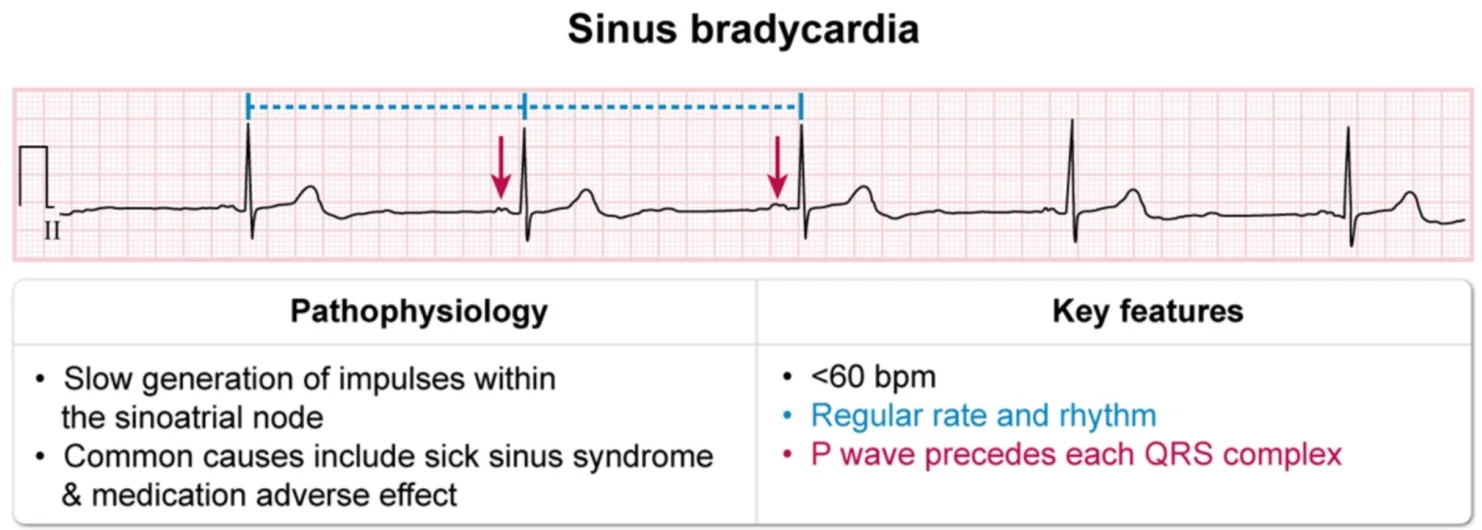
What this shows
Sinus bradycardia
a slow sinus rhythm: normal P waves before every QRS at under 60 per minute.Benign
sleep, well-conditioned athletes.Drugs
beta blockers, calcium-channel blockers.Pathologic
sinoatrial node disease, raised intracranial pressure (the Cushing triad of bradycardia, hypertension and irregular breathing), obstructive sleep apnea, hypothyroidism.Vagal
bradycardia and atrioventricular (AV) block right after carbon dioxide insufflation at laparoscopy come from peritoneal stretch.- The high abdominal pressure can also raise vascular resistance and blood pressure, so monitor closely.
Respiratory sinus arrhythmia
physiologic, especially in the young; the R-R interval shortens on inspiration and lengthens on expiration.Clinical features and diagnosis
Usually asymptomatic until the rate falls below 45
then fatigue, dizziness, syncope.Unstable bradycardia
any of acute altered mental status, ischemic chest pain, acute heart failure, hypotension, or shock despite an adequate airway and breathing.Every patient
a 12-lead electrocardiogram (ECG), cardiac monitoring, pulse oximetry and intravenous access.Management
Stable or mildly symptomatic
no acute intervention; find and treat the cause.Correct reversible causes alongside any treatment
hypoxia, hyperkalemia, acute coronary syndrome, and beta blocker, calcium-channel blocker or digoxin toxicity.- A reversible cause does not need a pacemaker.
Unstable
in order.- Intravenous atropine: 1 mg, repeated every 3 to 5 minutes to 3 mg, as in the Symptomatic bradycardia pathway.
- Refractory: transcutaneous pacing and/or an infusion of dopamine or epinephrine.
- Still refractory: cardiology for transvenous pacing.
A patient with a heart rate of 38 is confused and has a blood pressure of 78/44. What is the first drug and dose, and what follows if it fails?
Unstable bradycardia: intravenous atropine 1 mg, repeated every 3 to 5 minutes up to 3 mg. If it fails, transcutaneous pacing or a dopamine or epinephrine infusion, then transvenous pacing, while reversible causes are corrected.
How it's tested
A marathon runner with a resting heart rate of 42, asymptomatic, normal P waves: athletic bradycardia — no treatment.
A 70-year-old on metoprolol and diltiazem with a rate of 36, BP 78/50 and confusion: unstable bradycardia — atropine 1 mg, then transcutaneous pacing or dopamine; stop the drugs; glucagon if beta-blocker toxicity dominates.
Head-injured patient with BP 200/110, pulse 45 and irregular breathing: Cushing triad — raised intracranial pressure; manage the ICP.
Sudden asystole as the surgeon insufflates the abdomen: vagal reflex from peritoneal stretch — desufflate and give atropine.
Fatigue and a heart rate of 48 with a TSH of 40: hypothyroid bradycardia — levothyroxine.
Go deeper
Guidelines: 2018 ACC/AHA/HRS Bradycardia and Conduction Delay Guideline · 2025 AHA Adult Advanced Life Support Guidance
Related Step 2 pages: Sick Sinus Syndrome, Atrioventricular Block, Beta-Blocker Toxicity, Cardiac Implantable Devices, Natriuretic Peptides & Cardiovascular Reflexes
High-yield images2
Flashcards for this page
Card 1 of 4 · try-out only, nothing is saved
You just read one page of 236
The rest of Step 2 CK, written exactly like this.
Rapid Review is the reading layer of a full Step 1 platform: a schedule fitted to your exam date, flashcards for every page, and a mentor a message away.
Every Step 1 system
Written the same way: what to know, how it’s tested, where to go deeper.
A plan built to your exam date
Tell us when you sit, and the schedule fits the whole library and your question bank to it.
Flashcards for every page
Ready-made spaced-repetition decks linked to each topic, so nothing you read gets forgotten.
