
Rapid Review·Cardiovascular
Select any text to highlight it or add a note.
Vascular: Aorta & Carotid
T1Must knowCarotid Artery Dissection
Focus on
A young adult with sudden neck pain and headache after a minor neck trauma or a fall with a toothbrush in the mouth, then a partial Horner syndrome and an MCA-territory stroke. CT or MR angiography shows the flap; antithrombotic therapy (anticoagulation or antiplatelets) prevents the next embolus. Vertebral dissection is the occipital-headache, Wallenberg-stroke twin.
Key takeaways
What it is and who gets it
Carotid artery dissection
injury to the arterial intima lets blood into the vessel wall, forming an intramural hematoma, false lumen or aneurysm.- It narrows the lumen and, more importantly, gives a thrombogenic surface for embolism to the brain or retina (stroke, transient ischemic attack).
The leading cause of stroke in the young
patients in their 30s and 40s.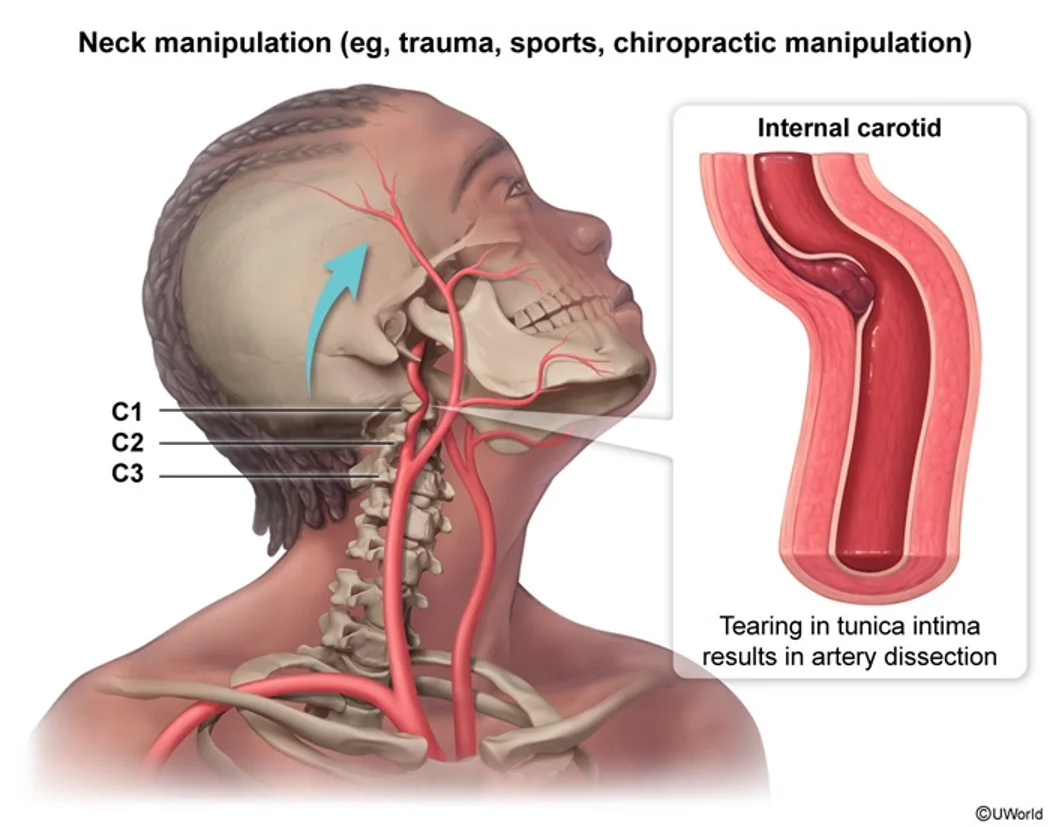
What this shows
Spontaneous, after infection, or after minor trauma
sports injuries, falls, neck manipulation, hyperextension.- Classically falling with an object in the mouth (a toothbrush), the posterior oropharyngeal injury shown on the See how posterior oropharyngeal trauma injures the carotid.
Connective-tissue disorders
fibromuscular dysplasia and Ehlers-Danlos syndrome.Clinical features
Pain first
sudden jaw or neck pain and an ipsilateral headache (constant, severe, throbbing, or thunderclap from vascular distension), then neurologic deficits in the anterior or middle cerebral artery territory.Partial Horner syndrome (ptosis and miosis without anhidrosis)
the sympathetic fibers to the facial sweat glands travel on the external carotid, while the oculosympathetic fibers run on the internal carotid.Local signs
pulse-synchronous tinnitus, a carotid bruit, neck swelling from hematoma, reduced taste, and lower cranial nerve palsies (VI to XII).Ischemia hours to days later
amaurosis fugax, a middle cerebral artery infarction.| Internal carotid dissection | Vertebral artery dissection | |
|---|---|---|
| Pain | Ipsilateral headache and facial or neck pain | Occipital headache and posterior nuchal pain |
| Local signs | Partial Horner (ptosis, miosis), pulse-synchronous tinnitus, neck swelling, reduced taste, cranial nerve lesions | Few local signs |
| Ischemic syndrome | Middle cerebral artery infarction, amaurosis fugax | Wallenberg (lateral medullary) syndrome: vertigo, ataxia, ipsilateral facial pain and numbness, contralateral loss of pain and temperature, dysphagia, dysarthria, hoarseness, nausea (Vertebrobasilar Insufficiency) |
| Horner mechanism | Ascending sympathetic fibers around the carotid (peripheral, no anhidrosis) | Descending sympathetic fibers in the brainstem (central, with anhidrosis) |
Diagnosis
Angiography is first-line
magnetic resonance (MR) or computed tomography (CT) angiography shows irregular asymmetric vessels, an intimal flap, a double lumen, an intramural hematoma; plus brain imaging for infarction.Duplex ultrasound
shows a high-resistance or absent flow pattern but misses distal dissections.Catheter angiography
rarely needed.Spontaneous dissection
screen for fibromuscular dysplasia.Management and complications
Antithrombotic therapy to prevent embolism, for 3 to 6 months
outcomes are equivalent between the options.- Low bleeding risk: parenteral then oral anticoagulation, or dual antiplatelet therapy.
- Moderate bleeding risk: dual or single antiplatelet therapy.
Acute ischemic stroke is treated like any other stroke
alteplase thrombolysis (the hematoma-extension risk is similar to other strokes) and mechanical thrombectomy for a large-vessel occlusion.Endovascular stenting
for recurrent ischemia despite medical therapy or an enlarging pseudoaneurysm.- Repeat imaging at 3 to 6 months, because most heal.
Complications
ischemic stroke and retinal infarction, pseudoaneurysm, subarachnoid hemorrhage with intracranial extension, persistent Horner syndrome.A 38-year-old has sudden left neck pain and headache after a chiropractic session, with left ptosis and miosis but normal sweating. What is the diagnosis, the imaging, and the treatment?
Left internal carotid artery dissection (partial Horner: the sweat fibers run on the external carotid). CT or MR angiography; treat with antithrombotic therapy for 3 to 6 months (anticoagulation or dual antiplatelet), and treat a stroke like any other (alteplase, thrombectomy).
How it's tested
A 38-year-old woman develops left neck pain and headache after a chiropractic adjustment, then left ptosis and miosis with normal facial sweating, and two days later right arm weakness: left internal carotid dissection — CT angiography, then antithrombotic therapy; thrombolysis if within the window for the stroke.
Why is sweating preserved: the facial sudomotor fibers travel with the external carotid, so a carotid dissection gives a partial Horner.
A toddler who fell with a toothbrush in his mouth is brought in drowsy with hemiparesis 12 hours later: carotid dissection from posterior oropharyngeal trauma — CT angiography.
Occipital headache and vertigo after a roller-coaster ride, then ataxia, ipsilateral facial numbness and contralateral loss of pain sensation: vertebral artery dissection with a Wallenberg stroke.
Should the dissection patient with a 4-hour-old MCA stroke get alteplase: yes — dissection does not contraindicate thrombolysis.
Go deeper
Guidelines: 2021 AHA/ASA Secondary Stroke Prevention Guideline
Related Step 2 pages: Carotid Artery Stenosis, Vertebrobasilar Insufficiency, Fibromuscular Dysplasia, Aortic Dissection, Approach to Aortic Syndromes
High-yield images2
Flashcards for this page
Card 1 of 1 · try-out only, nothing is saved
You just read one page of 236
The rest of Step 2 CK, written exactly like this.
Rapid Review is the reading layer of a full Step 1 platform: a schedule fitted to your exam date, flashcards for every page, and a mentor a message away.
Every Step 1 system
Written the same way: what to know, how it’s tested, where to go deeper.
A plan built to your exam date
Tell us when you sit, and the schedule fits the whole library and your question bank to it.
Flashcards for every page
Ready-made spaced-repetition decks linked to each topic, so nothing you read gets forgotten.
