
Rapid Review·Cardiovascular
Select any text to highlight it or add a note.
Hypertension & Lipids
T2High yieldHyperlipidemia
Focus on
Four statin groups (clinical ASCVD, LDL ≥ 190, diabetes at 40–75, and 10-year risk), the intensity each one gets, what to do when the LDL is still above 70, and the triglyceride fork where the goal switches from atherosclerosis to pancreatitis prevention.
Key takeaways
Overview and causes
Hyperlipidemia is silent
its whole importance is atherosclerotic cardiovascular disease (ASCVD) risk (myocardial infarction (MI), stroke, peripheral artery disease (PAD)).- Low-density lipoprotein (LDL) cholesterol drives atherosclerosis.
- Very high triglycerides (TG) cause pancreatitis.
Screening
a lipid panel for adults and a two-step schedule for children.- Adults: screen from age 20 every 4 to 6 years (annually with risk factors).
- Children: once at 9 to 11 and again at 17 to 21, earlier with family history of premature ASCVD or familial hypercholesterolemia.
Primary causes
polygenic (most), familial hypercholesterolemia and the other Genetic Dyslipidemias.Secondary causes
check them before labeling a lipid disorder primary.- Diabetes and obesity (high TG, low high-density lipoprotein (HDL)).
- Hypothyroidism (high LDL), nephrotic syndrome, cholestasis, alcohol (TG), pregnancy.
- Drugs: thiazides, beta blockers, glucocorticoids, oral estrogens, retinoids, antiretrovirals, cyclosporine.
- Check thyroid-stimulating hormone (TSH), glucose, renal and liver function before labeling a lipid disorder primary.
Clinical features
Usually none
generally asymptomatic unless levels are very high.Very high LDL
three skin and eye signs.- Tendon xanthomas (Achilles, finger extensors), nearly pathognomonic for familial hypercholesterolemia.
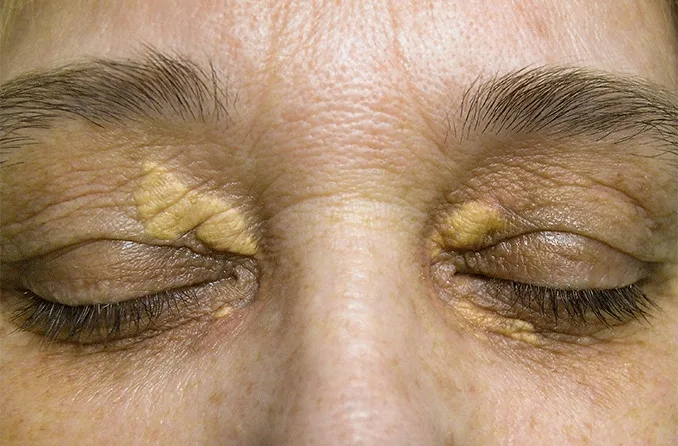
- Xanthelasma: lipid plaques on the eyelids.
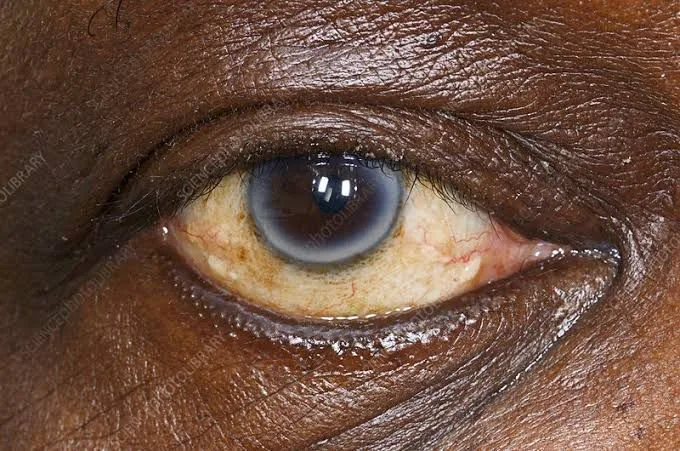
- Corneal arcus: common in older adults (arcus senilis) but appears earlier in life with hypercholesterolemia.
Very high triglycerides
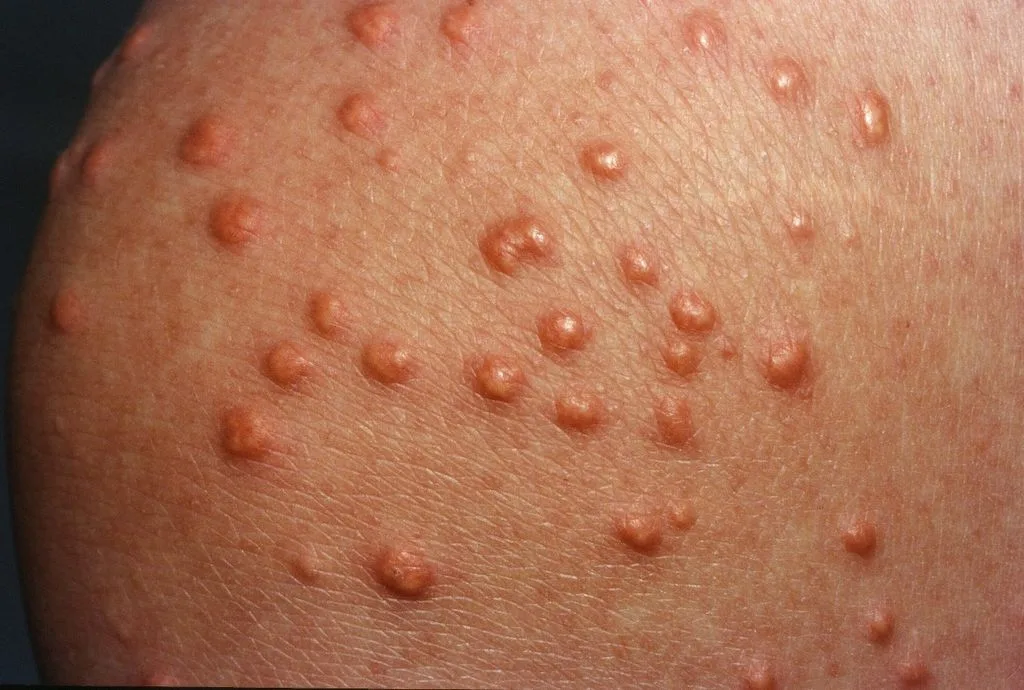
eruptive xanthomas on the buttocks and extensors.- Also lipemia retinalis, hepatosplenomegaly, and recurrent pancreatitis.
Palmar and tuberoeruptive xanthomas
point to dysbetalipoproteinemia.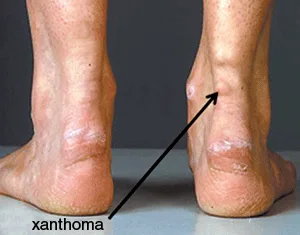
What this shows
Diagnosis and statins
Diagnosis and risk assessment
fasting or non-fasting panel (fasting if TG > 400).- Calculate the 10-year ASCVD risk.
Management, lifestyle for everyone
heart-healthy diet (Mediterranean/Dietary Approaches to Stop Hypertension (DASH) pattern, less saturated and trans fat).- Weight loss, ≥ 150 min/week of moderate exercise, smoking cessation, limited alcohol.
- Tight glycemic control in diabetes.
Management, statins
statins are first line for ASCVD risk reduction; the decision is driven by risk group, not by the LDL number alone.- Doses, moderate-intensity choices and the other drug classes are on Lipid-Lowering Therapy.
- The four groups are also summarized on the statins table.
| Group | Definition | Intensity |
|---|---|---|
| Clinical ASCVD (secondary prevention) | Acute coronary syndrome (ACS), stable angina, prior revascularization, ischemic stroke/transient ischemic attack (TIA), PAD | High intensity if ≤ 75 (or very high risk); moderate if > 75 or intolerant |
| Severe hypercholesterolemia | LDL ≥ 190 mg/dL | High intensity |
| Diabetes, age 40 to 75 | Regardless of other factors | Moderate; high if multiple risk factors or 10-year risk ≥ 20% |
| Primary prevention by risk | 10-year ASCVD risk ≥ 7.5 to 10% (discuss at 5 to 7.5% with patient) | Moderate to high depending on risk |
Targets and monitoring
the goal depends on intensity and on whether ASCVD is established.- Aim for ≥ 50% LDL reduction on a high-intensity statin and 30 to 49% on moderate intensity.
- In established ASCVD, an LDL < 70 mg/dL.
- Recheck lipids 4 to 12 weeks after any change, then every 3 to 12 months.
Escalation
a fixed order.- Maximal statin.
- Still above goal, add ezetimibe.
- Still above goal, add a PCSK9 inhibitor: a proprotein convertase subtilisin/kexin type 9 (PCSK9) inhibitor (evolocumab, alirocumab) or bempedoic acid.
Baseline tests
check creatine kinase (CK) and liver function tests (LFT) before starting the statins; no need to repeat them unless the patient has symptoms.Statin myopathy management
hold 2 to 4 weeks.- If symptoms resolve, restart at a lower dose or switch to a lower-risk statin (pravastatin, fluvastatin, pitavastatin) or alternate-day rosuvastatin.
- Stop permanently only for rhabdomyolysis or a CK > 10× normal.
- Check for interactions (fibrates, macrolides, azoles, cyclosporine, grapefruit) and hypothyroidism.
Hypertriglyceridemia
Fix secondary causes first
sugar and alcohol intake, uncontrolled diabetes, hypothyroidism, nephrotic syndrome, estrogens, beta blockers, thiazides.- Limit dietary sugar and saturated fat.
- Weight loss of 5 to 10% and aerobic exercise lower TG substantially.
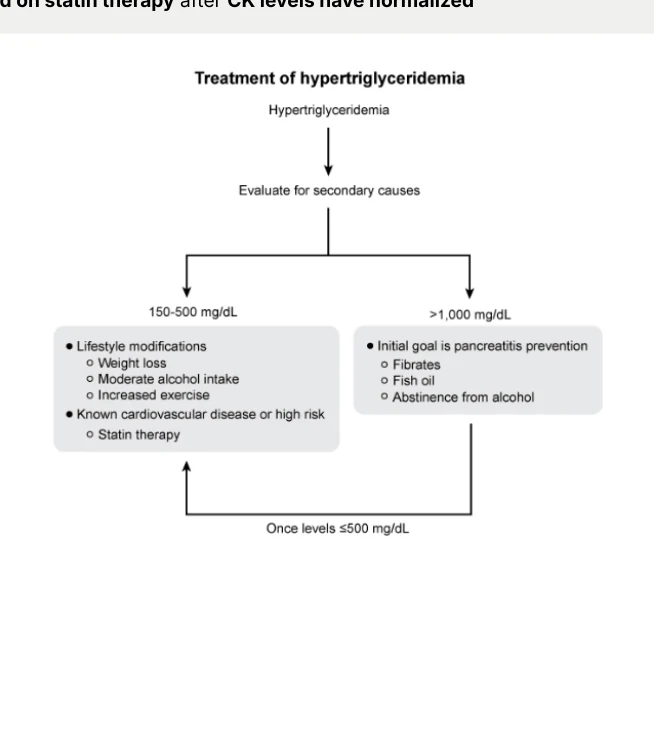
What this shows
The level chooses the goal
as on the hypertriglyceridemia decision flow.- Fibrates are indicated only at TG ≥ 500 mg/dL.
- Statins are used below 500 when ASCVD risk is high.
| Triglycerides | Goal | Specific measures |
|---|---|---|
| 150 to 499 mg/dL | ASCVD risk reduction | Lifestyle, limit alcohol; statin by ASCVD risk; icosapent ethyl if high risk on a statin |
| 500 to 999 mg/dL | Both | Abstain from alcohol; fibrate or omega-3 depending on ASCVD risk; statin if indicated |
| ≥ 1,000 mg/dL | Prevent pancreatitis | Abstain from alcohol, very-low-fat diet, fibrate (fenofibrate) ± omega-3; insulin if hyperglycemic; plasmapheresis only for severe pancreatitis with organ failure |
Complications and special situations
Complications
atherosclerotic disease everywhere (Stable Angina, carotid, Peripheral Artery Disease).- Triglyceride pancreatitis.
- After arterial instrumentation, atheroembolism (Cholesterol Embolism Syndrome).
Familial hypercholesterolemia
LDL ≥ 190 with tendon xanthomas or premature ASCVD in a first-degree relative.- Start a high-intensity statin.
- Screen relatives (cascade screening).
- Children are treated from about age 8 to 10.
Pregnancy
stop statins (traditionally) and PCSK9 inhibitors; bile acid sequestrants are the safe option.Older adults > 75
continue a statin already in place; starting one is an individualized decision.A post-MI patient on atorvastatin 80 mg still has an LDL of 95 mg/dL. What comes next, and what if it stays above 70?
The patient has clinical ASCVD, so the target is an LDL < 70 mg/dL on a maximal statin. Add ezetimibe next; if the LDL is still above 70, add a PCSK9 inhibitor (evolocumab or alirocumab) or bempedoic acid.
How it's tested
A 52-year-old with an LDL of 195 mg/dL and no other disease: high-intensity statin — LDL ≥ 190 is a statin group on its own, independent of the risk calculator.
A diabetic man of 58 with an LDL of 110: moderate-intensity statin at minimum; high intensity if his 10-year risk is ≥ 20%.
Post-MI patient on atorvastatin 80 mg with an LDL of 95: add ezetimibe; if still above 70, a PCSK9 inhibitor.
Triglycerides of 1,800 mg/dL with epigastric pain radiating to the back: the goal is pancreatitis prevention — alcohol abstinence, a fibrate and a very-low-fat diet, insulin if hyperglycemic; the statin question comes later.
Diffuse myalgias with a CK three times normal on rosuvastatin 40 mg: hold, wait for resolution, rechallenge at a lower dose or with pravastatin — do not abandon prevention; stop for good only with rhabdomyolysis.
Go deeper
Guidelines: 2026 ACC/AHA Multisociety Guideline on the Management of Dyslipidemia
Related Step 2 pages: Lipid-Lowering Therapy, Genetic Dyslipidemias, Stable Angina, Cholesterol Embolism Syndrome, Hypertension
High-yield images7
Flashcards for this page
Card 1 of 5 · try-out only, nothing is saved
You just read one page of 236
The rest of Step 2 CK, written exactly like this.
Rapid Review is the reading layer of a full Step 1 platform: a schedule fitted to your exam date, flashcards for every page, and a mentor a message away.
Every Step 1 system
Written the same way: what to know, how it’s tested, where to go deeper.
A plan built to your exam date
Tell us when you sit, and the schedule fits the whole library and your question bank to it.
Flashcards for every page
Ready-made spaced-repetition decks linked to each topic, so nothing you read gets forgotten.
