
Rapid Review·Cardiovascular
Select any text to highlight it or add a note.
Hypertension & Lipids
T1Must knowSecondary Hypertension
Focus on
Know when to look (young, abrupt, resistant, new diastolic hypertension in the elderly, or a clue on the routine workup) and match each clue to its first test: hypokalemia → aldosterone/renin ratio; bruit or creatinine jump on an ACE inhibitor → renal Doppler; spells → metanephrines.
Key takeaways
Overview
About 5 to 10% of high blood pressure (BP) has an identifiable, often curable cause
the four facts to know.- Renal parenchymal disease is the most common overall.
- Primary aldosteronism is the most common endocrine cause and is under-diagnosed (many patients have a normal potassium).
- Fibromuscular dysplasia (FMD) is the renovascular cause in young women.
- Atherosclerosis is the renovascular cause in older smokers.
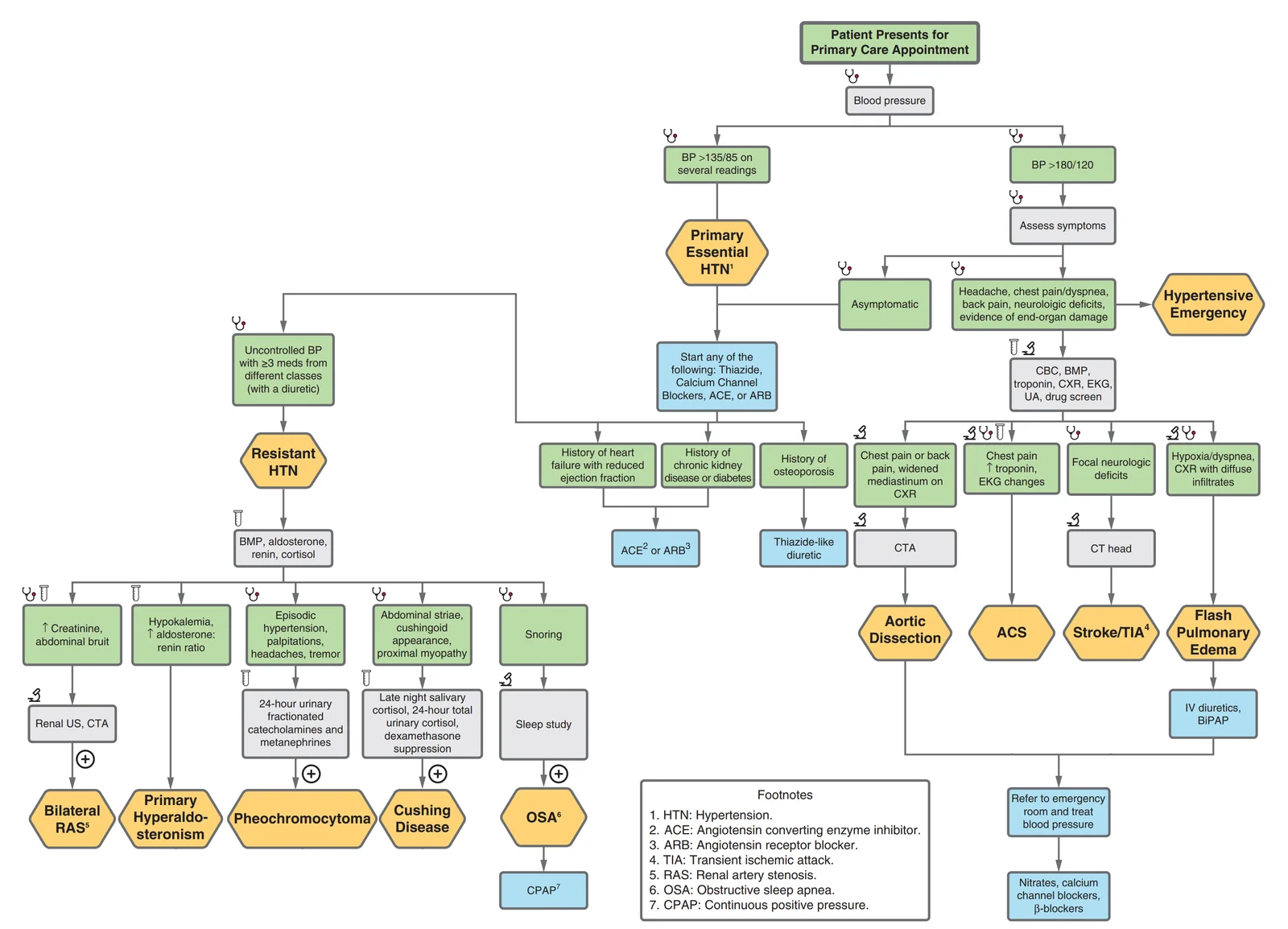
What this shows
When to evaluate
Look for a secondary cause in these patients
one of these patterns.- Onset before 30 (especially without family history or obesity).
- Abrupt onset (over months) or acute worsening in a previously controlled patient.
- Hypertension resistant to three drugs.
- New diastolic hypertension after 65.
- Severe or malignant hypertension.
Or a specific clue
hypokalemia, abdominal bruit, hematuria/proteinuria, paroxysmal symptoms, cushingoid features, snoring, hypercalcemia, delayed femoral pulses, or hormonal contraception.Everyone gets the baseline panel
basic metabolic panel (BMP), urinalysis, albumin/creatinine ratio, thyroid-stimulating hormone (TSH), glucose, lipids, electrocardiogram (ECG).- The clue decides the targeted test.
Clinical clues and first tests
Review the medication list before ordering endocrine tests
do not stop the offending drugs blindly.- Many patients are on NSAIDs, decongestants, oral contraceptives, stimulants, glucocorticoids, calcineurin inhibitors, erythropoietin, vascular endothelial growth factor (VEGF) inhibitors, licorice or cocaine.
| Cause | Key features | Initial test | Treatment |
|---|---|---|---|
| Chronic kidney disease (most common) | Raised creatinine, proteinuria, hematuria, edema | Creatinine/eGFR, urinalysis, renal ultrasound | ACEi/ARB, treat the nephropathy |
| Renal artery stenosis | Abdominal bruit, creatinine rise > 30% after ACEi/ARB, recurrent flash pulmonary edema, asymmetric kidneys; FMD in young women, atherosclerosis in older smokers | Renal duplex ultrasound; computed tomography (CT) or magnetic resonance (MR) angiography | Medical therapy (ACEi/ARB if bilateral function allows); angioplasty for Fibromuscular Dysplasia or refractory atherosclerotic disease |
| Primary hyperaldosteronism | Hypokalemia (spontaneous or on a thiazide), metabolic alkalosis, resistant hypertension; K often normal | Plasma aldosterone/renin ratio (stop MRA; correct K), then confirmatory salt loading and adrenal CT/vein sampling | Adrenalectomy for adenoma; spironolactone/eplerenone for bilateral hyperplasia |
| Pheochromocytoma | Paroxysms of headache, palpitations, sweating; labile or crisis BP; multiple endocrine neoplasia type 2 (MEN2), von Hippel-Lindau (VHL), neurofibromatosis type 1 (NF1) | Plasma free or 24-h urine fractionated metanephrines, then CT/magnetic resonance imaging (MRI) | Alpha blockade (phenoxybenzamine) before beta blockade, then surgery |
| Cushing syndrome | Moon face, central obesity, striae, proximal weakness, hyperglycemia, bruising | 24-h urine cortisol, late-night salivary cortisol, or 1 mg dexamethasone suppression | Treat the source (pituitary adenoma, adrenal, ectopic, exogenous steroids) |
| Coarctation of the aorta | Arm > leg BP, brachial-femoral delay, rib notching, murmur over the back; Turner syndrome | Echocardiography; CT/MR angiography | Balloon angioplasty/stent or surgical repair (Coarctation of Aorta) |
| Obstructive sleep apnea | Snoring, witnessed apneas, daytime sleepiness, large neck, resistant hypertension | Polysomnography | Continuous positive airway pressure (CPAP), weight loss |
| Primary hyperparathyroidism | Hypercalcemia, kidney stones, bone pain, constipation, neuropsychiatric symptoms | Parathyroid hormone (PTH) with calcium | Parathyroidectomy |
| Thyroid disease | Hyperthyroidism: systolic hypertension with wide pulse pressure; hypothyroidism: diastolic hypertension | TSH (already on the routine panel) | Treat the thyroid |
| Drugs and substances | Oral contraceptives, NSAIDs, decongestants, stimulants, glucocorticoids, cyclosporine, alcohol, licorice, cocaine | History | Stop or substitute |
| Acromegaly | Enlarging hands and jaw, sweating, sleep apnea | Insulin-like growth factor 1 (IGF-1) | Pituitary surgery |
Diagnosis in practice
Renovascular disease: an ACE inhibitor unmasks it
bilateral stenosis (or a solitary kidney) loses glomerular filtration rate (GFR) when efferent tone falls.- So a > 30% creatinine rise within two weeks of starting an angiotensin-converting enzyme (ACE) inhibitor or angiotensin receptor blocker (ARB) is a stenosis clue.
- Do duplex first because it is cheap and needs no contrast; CT angiography when renal function allows.
Primary aldosteronism: the screen is a ratio
a high aldosterone with suppressed renin (ratio > 20 to 30 with aldosterone > 15 ng/dL).Pheochromocytoma: biochemistry before imaging
an incidental adrenal mass without biochemical evidence is not a pheochromocytoma.Management principles
Cure the cause where possible
adenoma, coarctation, FMD, offending drug.Otherwise match the drug to the mechanism
control the pressure with drugs aimed at the cause.- MRA for aldosteronism.
- Alpha then beta blockade for pheochromocytoma.
- ACEi/ARB for chronic kidney disease (CKD) and unilateral renovascular disease.
Keep screening for end-organ damage
as for primary hypertension.Pediatric secondary hypertension
prepubertal children have renal parenchymal disease (reflux scarring, glomerulonephritis), then renal artery stenosis and coarctation.- Renal ultrasound with Doppler is the first study.
- Angioplasty or stenting treats renovascular disease after medical control.
Resistant hypertension with potassium 3.1 and bicarbonate 32 in a patient on no diuretic. What is the first test, and which common drug would make it falsely positive?
Primary aldosteronism: start with the plasma aldosterone/renin ratio (high aldosterone, suppressed renin), never straight to adrenal CT. Beta blockers lower renin and can make the ratio falsely positive.
How it's tested
A 24-year-old woman with BP 160/100 and an epigastric bruit: fibromuscular dysplasia — renal duplex or CT angiography, then angioplasty.
Creatinine climbs from 1.1 to 1.9 two weeks after lisinopril; the patient has widespread atherosclerosis: bilateral renal artery stenosis — stop the ACE inhibitor and image the renal arteries.
Resistant hypertension with potassium 3.1 and bicarbonate 32 on no diuretic: primary aldosteronism — aldosterone-to-renin ratio first, never straight to adrenal CT.
Episodic pounding headaches, sweating and palpitations with BP 220/120 during an episode: pheochromocytoma — plasma metanephrines; alpha blockade before any beta blocker.
A teenager with upper-limb hypertension, weak femoral pulses and rib notching on the film: coarctation of the aorta — echocardiogram.
Go deeper
Guidelines: 2025 ACC/AHA High Blood Pressure in Adults Guideline
Related Step 2 pages: Hypertension, Fibromuscular Dysplasia, Coarctation of Aorta, Antihypertensive Drugs
High-yield images1
You just read one page of 236
The rest of Step 2 CK, written exactly like this.
Rapid Review is the reading layer of a full Step 1 platform: a schedule fitted to your exam date, flashcards for every page, and a mentor a message away.
Every Step 1 system
Written the same way: what to know, how it’s tested, where to go deeper.
A plan built to your exam date
Tell us when you sit, and the schedule fits the whole library and your question bank to it.
Flashcards for every page
Ready-made spaced-repetition decks linked to each topic, so nothing you read gets forgotten.
