
Rapid Review·Cardiovascular
Select any text to highlight it or add a note.
Hypertension & Lipids
T2High yieldGenetic Dyslipidemias
Focus on
Five patterns, each recognized by what is elevated and one physical clue: chylomicrons and pancreatitis in a child (type I), tendon xanthomas and an MI at 35 (type II), palmar xanthomas (type III), VLDL with insulin resistance (type IV), and the fat-malabsorbing child with acanthocytes and ataxia (abetalipoproteinemia).
Key takeaways
Overview
Inherited defects in lipoprotein synthesis, receptors or clearance
the Fredrickson types are recognized by the lipoprotein that accumulates.- Familial hypercholesterolemia (type II) is by far the most common and the most testable.
Suspect a genetic disorder
when one of these is present.- Lipids are extreme: low-density lipoprotein (LDL) ≥ 190, triglycerides (TG) ≥ 1,000.
- Disease starts young.
- Xanthomas are present.
- A first-degree relative had atherosclerotic cardiovascular disease (ASCVD) before 55 (men) or 65 (women).
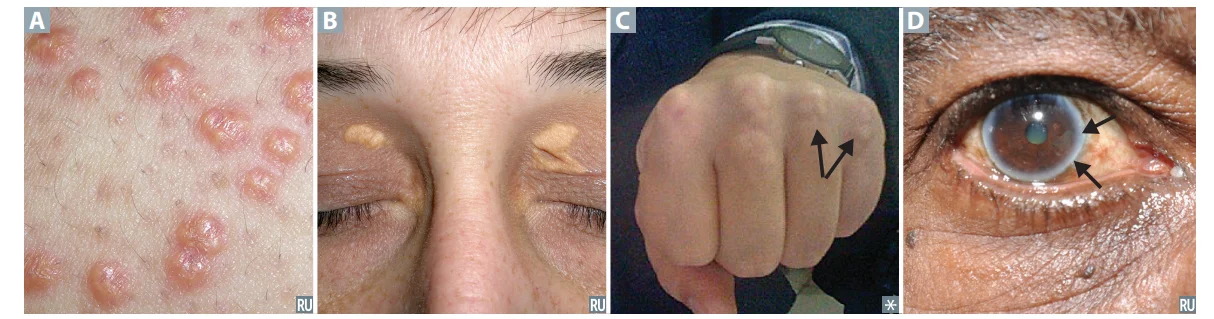
What this shows
| Type | Name | Defect | Inheritance | Elevated | Clinical hallmark |
|---|---|---|---|---|---|
| I | Hyperchylomicronemia | Lipoprotein lipase or apo C-II deficiency | Autosomal recessive (AR) | Chylomicrons, TG (and cholesterol) | Childhood pancreatitis, eruptive xanthomas, hepatosplenomegaly, lipemia retinalis, creamy plasma layer; no increased atherosclerosis |
| IIa | Familial hypercholesterolemia | Absent/defective LDL receptor or apo B-100 | Autosomal dominant (AD) | LDL, cholesterol | Heterozygotes ~1:250 to 500 with cholesterol ≈ 300; homozygotes ≥ 700 with myocardial infarction (MI) before 20; tendon xanthomas, corneal arcus |
| IIb | Familial combined hyperlipidemia | Overproduction of apo B / very-low-density lipoprotein (VLDL) | AD | LDL and VLDL | Premature coronary artery disease (CAD), mixed pattern varying within families |
| III | Dysbetalipoproteinemia | Apo E2/E2 (defective in type thrEE) | AR (plus a second hit) | Chylomicron and VLDL remnants (intermediate-density lipoprotein, IDL) | Palmar and tuberoeruptive xanthomas, premature peripheral and coronary disease |
| IV | Familial hypertriglyceridemia | Hepatic VLDL overproduction | AD | VLDL, TG | TG often > 1,000, then pancreatitis; associated with insulin resistance and obesity |
Familial hypercholesterolemia in practice
Diagnose clinically (Dutch Lipid Clinic / Simon Broome)
LDL ≥ 190 in adults (≥ 160 in children) plus tendon xanthomas or a family history of premature ASCVD or very high LDL.- Genetic testing confirms.
Treat early and hard
a stepwise plan.- High-intensity statin from diagnosis: children from about 8 to 10.
- Ezetimibe.
- PCSK9 inhibitor: a proprotein convertase subtilisin/kexin type 9 (PCSK9) inhibitor.
- Homozygotes may need lomitapide, evinacumab or LDL apheresis.
Cascade-screen every first-degree relative
half are affected.Chylomicronemia and severe hypertriglyceridemia
Age of onset separates the causes
type I presents in childhood; type IV and secondary causes (uncontrolled diabetes, alcohol, estrogens, obesity) present in adults.Above ~1,000 mg/dL the priority is pancreatitis
a combined plan.- Very-low-fat diet, alcohol abstinence.
- Fibrates and omega-3s; insulin if hyperglycemic.
- Medium-chain triglycerides in lipoprotein lipase (LPL) deficiency, because they bypass chylomicrons.
Abetalipoproteinemia
Autosomal recessive mutation in microsomal triglyceride transfer protein (MTP)
the cell cannot assemble apo B-containing lipoproteins (apo B-48 and B-100).- So chylomicrons, VLDL and LDL are absent.
- Plasma cholesterol and TG are very low.
Infancy
fat malabsorption, steatorrhea and failure to thrive.Later, fat-soluble vitamin deficiency (especially vitamin E)
three neurologic and eye problems plus a blood sign.- Spinocerebellar degeneration (progressive ataxia).
- Retinitis pigmentosa and peripheral neuropathy.
- Blood smear shows acanthocytes.
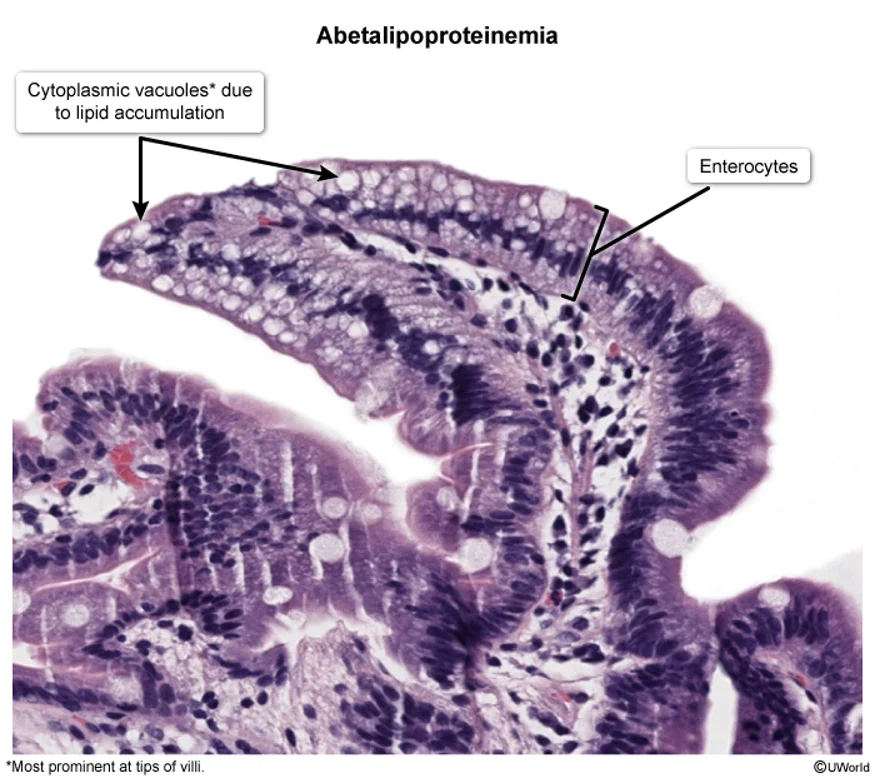
What this shows
Intestinal biopsy
lipid-laden enterocytes.Treatment
restrict long-chain fatty acids, supplement medium-chain triglycerides, and give large doses of oral vitamin E (plus A, D, K).Related low-HDL and other patterns
Tangier disease (ABCA1)
near-absent high-density lipoprotein (HDL), orange tonsils, neuropathy.Familial hypoalphalipoproteinemia
raises ASCVD risk.Lipoprotein(a) elevation
inherited and adds risk independent of LDL; measure once in premature ASCVD.A toddler has steatorrhea and failure to thrive, then later develops ataxia and night blindness; the blood smear shows acanthocytes. What is the defect, and what is the key treatment?
Abetalipoproteinemia: an autosomal recessive MTP mutation, so apo B-containing lipoproteins cannot be assembled and fat (and vitamin E) cannot leave the gut. Treat with restriction of long-chain fatty acids and large doses of oral vitamin E (plus A, D and K).
How it's tested
A 34-year-old man with an MI, thickened Achilles tendons and a father who died of an MI at 45: heterozygous familial hypercholesterolemia — high-intensity statin now and screen the children.
A 7-year-old with recurrent pancreatitis, eruptive xanthomas and plasma that separates into a creamy top layer: lipoprotein lipase (or apo C-II) deficiency — dietary fat restriction with medium-chain triglycerides.
Yellow-orange discoloration of the palmar creases with premature vascular disease: type III dysbetalipoproteinemia — apo E2/E2.
A toddler with steatorrhea, failure to thrive, acanthocytes on the smear and later ataxia and night blindness: abetalipoproteinemia — MTP mutation; high-dose vitamin E.
Go deeper
Related Step 2 pages: Hyperlipidemia, Lipid-Lowering Therapy, Stable Angina
High-yield images2
You just read one page of 236
The rest of Step 2 CK, written exactly like this.
Rapid Review is the reading layer of a full Step 1 platform: a schedule fitted to your exam date, flashcards for every page, and a mentor a message away.
Every Step 1 system
Written the same way: what to know, how it’s tested, where to go deeper.
A plan built to your exam date
Tell us when you sit, and the schedule fits the whole library and your question bank to it.
Flashcards for every page
Ready-made spaced-repetition decks linked to each topic, so nothing you read gets forgotten.
