
Rapid Review·Cardiovascular
Select any text to highlight it or add a note.
Coronary Artery Disease
T1Must knowCoronary Artery Disease
Focus on
Atherosclerosis of the coronary arteries, silent until the artery is severely narrowed. Know the risk factors (smoking is the strongest), the ages that make a family history premature (55 in men, 65 in women), and the CAD equivalents (diabetes, chronic kidney disease, atherosclerosis elsewhere). Smoking cessation is the most important step, and aspirin plus a statin reduce mortality.
Key takeaways
Overview
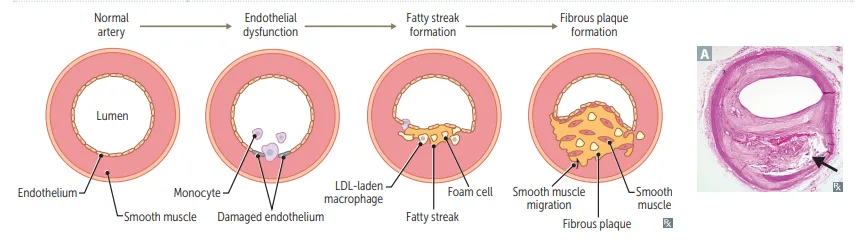
What this shows
Definition
atherosclerosis of the coronary arteries, a type of ischemic heart disease.- Coronary artery disease (CAD) is the leading cause of death in the US and worldwide.
- Usually silent until the plaque severely narrows the artery.
Presentations
- Fixed plaque, pain on exertion: Stable Angina.
- Plaque rupture with clot: Acute Coronary Syndrome.
- Spasm without a fixed plaque: Vasospastic Angina.
Risk Factors
Major risk factors
- Smoking: the strongest risk factor.
- Obesity and dyslipidemia.
- Hypertension.
- Male sex.
- Age over 45 in men, or over 55 (or after menopause) in women.
- Family history of premature CAD: a first-degree relative with CAD before 55 in a man or 65 in a woman.
CAD equivalents
presume these patients already have CAD.- Diabetes mellitus.
- Chronic kidney disease (CKD).
- Atherosclerosis outside the heart: Peripheral Artery Disease, Carotid Artery Stenosis, Abdominal Aortic Aneurysm.
Management
Lifestyle
- Smoking cessation: the most important step.
- Regular moderate exercise.
- Weight loss and a healthy diet.
- Mediterranean diet (fresh fruit, vegetables, legumes): lowers cardiovascular morbidity and mortality, with or without established CAD.
Drugs
- Aspirin and a statin: for every patient with any atherosclerotic cardiovascular disease (ASCVD), such as CAD, peripheral artery disease, aortic aneurysm or carotid stenosis; both reduce mortality.
- Treat comorbidities such as hypertension and diabetes.
A smoker with peripheral artery disease has no chest pain. How should he be treated, and what is the single most important step?
Peripheral artery disease is a CAD equivalent, so treat him as if he has CAD: aspirin and a statin, which reduce mortality. Smoking cessation is the most important step.
How it's tested
A 50-year-old with type 2 diabetes and no chest pain: diabetes is a CAD equivalent, so manage his risk as if he already has CAD.
Father had an MI at 58, mother at 60: only the mother counts as premature CAD (before 65 in a woman; before 55 in a man).
A patient with CAD asks which single change helps most: smoking cessation.
Which drugs reduce mortality in any atherosclerotic disease: aspirin and a statin.
Go deeper
Related Step 2 pages: Stable Angina, Acute Coronary Syndrome, Vasospastic Angina, Hyperlipidemia, Hypertension, Peripheral Artery Disease
High-yield images1
You just read one page of 237
The rest of Step 2 CK, written exactly like this.
Rapid Review is the reading layer of a full Step 1 platform: a schedule fitted to your exam date, flashcards for every page, and a mentor a message away.
Every Step 1 system
Written the same way: what to know, how it’s tested, where to go deeper.
A plan built to your exam date
Tell us when you sit, and the schedule fits the whole library and your question bank to it.
Flashcards for every page
Ready-made spaced-repetition decks linked to each topic, so nothing you read gets forgotten.
