
Rapid Review·Cardiovascular
Select any text to highlight it or add a note.
Congenital Heart Disease
T1Must knowEisenmenger Syndrome
Focus on
A left-to-right shunt left open long enough remodels the lungs, pulmonary pressure climbs past systemic, and the shunt reverses: a formerly acyanotic patient becomes cyanotic, clubbed and polycythemic with right heart failure. The defect can no longer be closed — it is the RV's pressure relief. Pulmonary vasodilators, careful phlebotomy only for symptomatic hyperviscosity, avoid pregnancy and dehydration, transplant when it fails.
Key takeaways
What it is
Eisenmenger syndrome
the severe late complication of an unrepaired left-to-right shunt: Ventricular Septal Defect most often, Patent Ductus Arteriosus, large Atrial Septal Defect after decades.The sequence
in order.- High flow: years of high pulmonary flow remodel the pulmonary vessels irreversibly.
- Pulmonary hypertension: develops, with right-ventricular hypertrophy.
- Reversal: the shunt reverses to right-to-left, producing cyanotic heart disease.
Clinical features and diagnosis
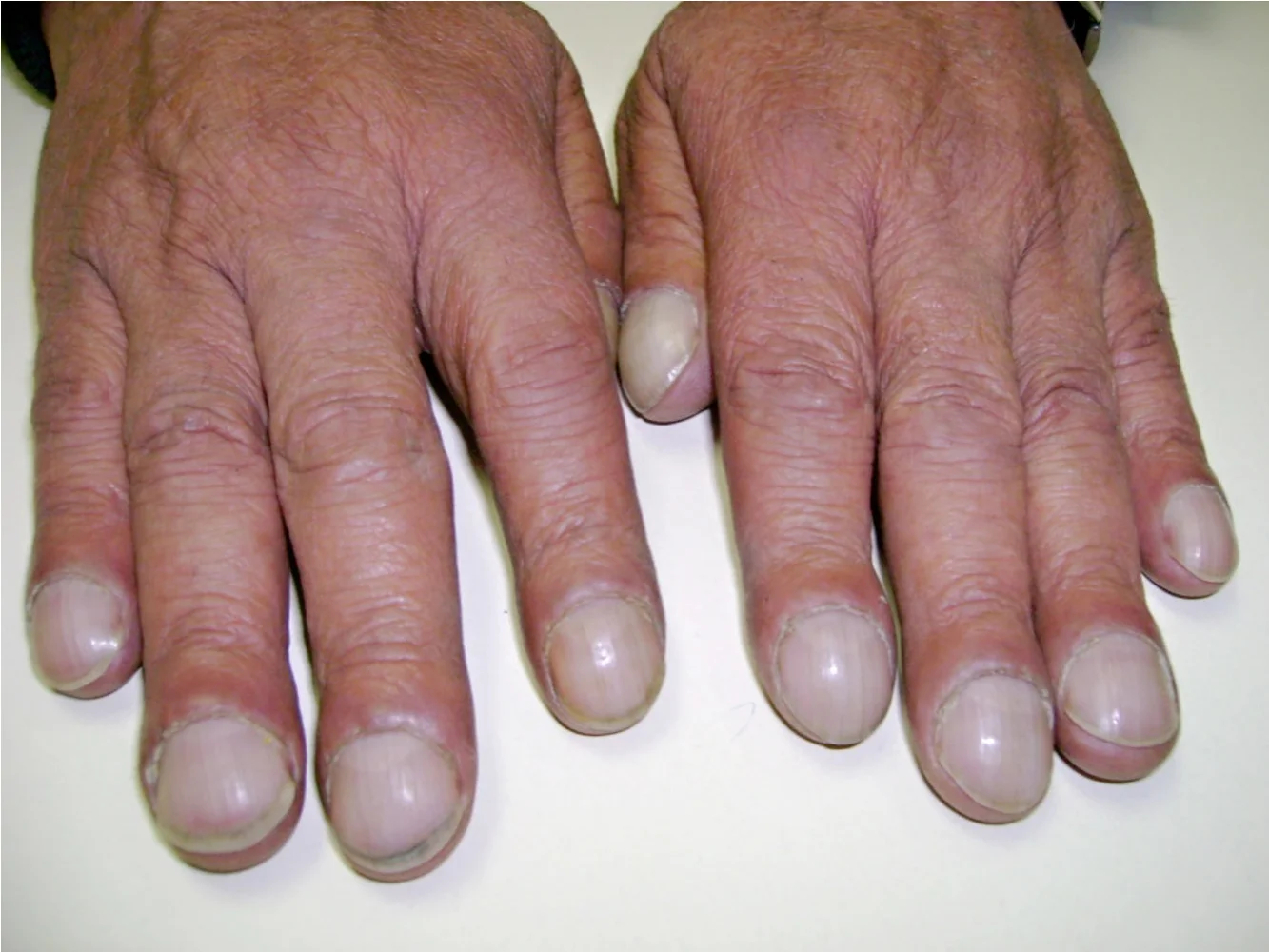
What this shows
Hypoxemia signs
digital clubbing, polycythemia, and cyanosis (differential, legs only, with a ductus); dyspnea, exercise intolerance, hemoptysis, hyperviscosity headaches.Heart sounds
a loud P2 with a narrowly split or single S2 (pulmonary hypertension); the original murmur is often gone because the pressures have equalized.Right heart failure
elevated jugular pressure, a left parasternal heave, hepatomegaly, leg edema.Labs
raised hemoglobin and hematocrit (secondary erythrocytosis from chronic hypoxemia) with thrombocytopenia; often iron deficiency.Echocardiography
the defect with bidirectional or right-to-left flow, right-ventricular hypertrophy, pulmonary pressure at or above systemic.Catheterization
measures pulmonary vascular resistance and vasoreactivity, which decides whether closure is still possible.Electrocardiogram and film
right ventricular hypertrophy and right axis; enlarged central pulmonary arteries with peripheral pruning.| Early large left-to-right shunt | Eisenmenger syndrome | |
|---|---|---|
| Shunt direction | Left to right | Right to left or bidirectional |
| Saturation | Normal | Cyanosis, clubbing |
| Murmur of the defect | Loud | Faint or absent; loud P2 |
| Pulmonary vascular markings | Increased (plethora) | Central enlargement with peripheral pruning |
| Hematocrit | Normal | Raised |
| Closure | Indicated (prevents this) | Contraindicated |
Management
Closure of the defect is contraindicated
with fixed pulmonary hypertension the right ventricle would fail without its pop-off.Definitive treatment
heart and/or lung transplantation with correction of the underlying defect.Supportive
pulmonary vasodilators (bosentan, sildenafil) improve exercise capacity; oxygen for symptoms; cautious diuretics for right heart failure.Erythrocytosis is compensatory
do not phlebotomize routinely.- Phlebotomy with isovolumic replacement only for symptomatic hyperviscosity with a hematocrit over 65 percent.
- Treat iron deficiency (rigid microcytic cells worsen viscosity).
What to avoid
pregnancy (maternal mortality 30 to 50 percent; progestin-only contraception), dehydration and vasodilating antihypertensives (both increase right-to-left shunting), high altitude, and air in intravenous lines (filters; paradoxical embolism).- Endocarditis prophylaxis for dental procedures.
Complications
right heart failure, atrial arrhythmias and sudden death, hemoptysis, hyperviscosity, paradoxical embolism and stroke, brain abscess, infective endocarditis, gout, catastrophic decompensation in pregnancy or surgery.A 30-year-old with a ventricular septal defect never repaired now has clubbing, cyanosis, a hematocrit of 62 percent, a loud P2 and no murmur. Should the defect be closed, and should she be phlebotomized?
Eisenmenger syndrome. No closure: it is contraindicated with fixed pulmonary hypertension (the definitive option is heart and/or lung transplantation with repair). No routine phlebotomy: the erythrocytosis is compensatory; phlebotomize only for symptomatic hyperviscosity with a hematocrit over 65 percent, and treat iron deficiency.
How it's tested
A 25-year-old immigrant with a known "hole in the heart" never repaired, now cyanotic and clubbed, with a loud P2 and a hematocrit of 62%; echo shows a large VSD with right-to-left flow and systemic-level pulmonary pressure: Eisenmenger syndrome — closure is contraindicated; pulmonary vasodilators, treat iron deficiency, contraception counseling.
Same patient with headache and blurred vision, hematocrit 70%: symptomatic hyperviscosity — isovolumic phlebotomy; but check for dehydration and iron deficiency first.
Should he be phlebotomized to a normal hematocrit at every visit: no — the erythrocytosis is compensatory; only symptomatic hyperviscosity is treated.
A woman with Eisenmenger syndrome asks about pregnancy: strongly advise against it (maternal mortality up to 50%); progestin-only or intrauterine contraception.
Fever, headache and a ring-enhancing brain lesion in a cyanotic adult with an unrepaired shunt: brain abscess from paradoxical septic embolism.
Go deeper
Guidelines: 2018 AHA/ACC Adult Congenital Heart Disease Guideline · 2022 ESC/ERS Pulmonary Hypertension Guideline
Related Step 2 pages: Ventricular Septal Defect, Atrial Septal Defect, Patent Ductus Arteriosus, Approach to Congenital Heart Disease, Cor Pulmonale, Infective Endocarditis
High-yield images1
You just read one page of 236
The rest of Step 2 CK, written exactly like this.
Rapid Review is the reading layer of a full Step 1 platform: a schedule fitted to your exam date, flashcards for every page, and a mentor a message away.
Every Step 1 system
Written the same way: what to know, how it’s tested, where to go deeper.
A plan built to your exam date
Tell us when you sit, and the schedule fits the whole library and your question bank to it.
Flashcards for every page
Ready-made spaced-repetition decks linked to each topic, so nothing you read gets forgotten.
