
Rapid Review·Cardiovascular
Select any text to highlight it or add a note.
Arrhythmias: Bradycardia & Devices
T1Must knowAtrioventricular Block
Focus on
Where the PR goes tells you the block: long and constant (first degree), lengthening until a beat drops (Mobitz I), constant with sudden drops (Mobitz II), or no relationship at all (complete). First degree and Wenckebach are benign; Mobitz II and complete block get a pacemaker unless the cause is reversible — drugs, ischemia, Lyme.
Key takeaways
What it is and what causes it
Atrioventricular (AV) block
abnormal conduction through the AV node or His bundle, graded by the electrocardiogram (ECG).Causes
degenerative fibrosis of the conduction system (idiopathic, the most common), and ischemic heart disease (second).Drugs
beta blockers, digoxin, calcium-channel blockers, adenosine, amiodarone.Other causes
congenital block, infiltrative cardiomyopathy (amyloidosis, sarcoidosis), and Lyme disease (late).Athletes
first-degree block and Mobitz I are physiologic in trained athletes from high vagal tone; Mobitz II and third-degree block never are.Clinical features
Symptoms
mostly asymptomatic with first-degree and Mobitz I; otherwise fatigue, dizziness, syncope, and palpitations with an irregular rhythm.Stokes-Adams attacks
sudden loss of consciousness with a brief prodrome, from ventricular asystole, most often in third-degree block.The four degrees
First-degree block
a PR interval over 200 ms (more than one large square) with every P wave conducted, as in the Recognize first-degree AV block.- Reassurance; no treatment unless symptomatic.
Second-degree, Mobitz I (Wenckebach)
progressive PR lengthening until a beat drops, in a regularly irregular grouped pattern, as in the Recognize Mobitz I Wenckebach; the block is in the AV node.- High vagal tone or drug toxicity (beta blockers, digitalis) causes it; it is generally benign.
- No treatment unless symptomatic; atropine or a temporary pacemaker if needed.
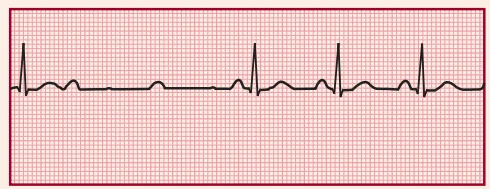
What this shows
Second-degree, Mobitz II
a constant PR interval with randomly dropped QRS complexes, usually a block below the node in the His bundle; the QRS may be narrow or wide.- It carries a high risk of progression to complete block, so it needs a pacemaker.
- A temporary pacemaker (or a beta-1 agonist such as isoproterenol or dobutamine) bridges to the permanent one.
Third-degree (complete) block
P waves and QRS complexes march independently, each at its own regular rate, with more P waves than QRS complexes and equal R-R intervals, as in the Complete heart block ECG.- Sudden onset can cause ventricular asystole; it can complicate late Lyme disease.
- Atropine and temporary pacing acutely, then a permanent pacemaker unless the cause is reversible (drugs, ischemia).
| Feature | Mobitz I | Mobitz II |
|---|---|---|
| Level of block | AV node | Below the node (His bundle) |
| ECG | Progressive PR prolongation, then a dropped QRS | Constant PR, randomly dropped QRS |
| QRS | Narrow | Narrow or wide |
| More vagal tone | Block worsens | Block improves |
| Less vagal tone | Block improves | Block worsens |
| Progression to complete block | Low | High (pacemaker) |
Pacemakers and intermittent block
The pacemaker rule
Mobitz II and third-degree block get a temporary pacemaker first while the cause is sought.- If a reversible cause (ischemia, drugs, vagal tone) explains it, no permanent pacemaker is needed.
Confirming an intermittent block
an older patient with presyncope, atrial fibrillation at a low-normal rate and a normal resting ECG needs ambulatory (Holter) monitoring to catch the block.An ECG shows a constant PR interval of 180 ms, with a P wave every so often not followed by a QRS and no PR lengthening before it. Where is the block, what is the risk, and what is the treatment?
Mobitz II second-degree AV block, usually below the node in the His bundle. It has a high risk of progression to complete block, so it needs a pacemaker (temporary first while reversible causes are excluded, then permanent).
How it's tested
Progressive PR lengthening then a dropped beat in an asymptomatic 25-year-old athlete: Mobitz I from vagal tone — reassurance.
Constant PR with intermittent dropped beats and a wide QRS in a 70-year-old with dizziness: Mobitz II — temporary pacing, then a permanent pacemaker.
P waves marching through a regular rhythm of 38 with a wide QRS, syncope: complete heart block — pacing.
Complete block in a hiker from Connecticut with a rash a month ago: Lyme carditis — IV ceftriaxone and temporary pacing; no permanent device.
Presyncope with AF and a low-normal rate on a normal resting ECG; you suspect intermittent block: ambulatory ECG monitoring to confirm.
Go deeper
Guidelines: 2018 ACC/AHA/HRS Bradycardia and Conduction Delay Guideline
Related Step 2 pages: Atrioventricular Block, Sinus Bradycardia, Bundle Branch Block, Cardiac Implantable Devices
High-yield images4
Flashcards for this page
Card 1 of 5 · try-out only, nothing is saved
You just read one page of 236
The rest of Step 2 CK, written exactly like this.
Rapid Review is the reading layer of a full Step 1 platform: a schedule fitted to your exam date, flashcards for every page, and a mentor a message away.
Every Step 1 system
Written the same way: what to know, how it’s tested, where to go deeper.
A plan built to your exam date
Tell us when you sit, and the schedule fits the whole library and your question bank to it.
Flashcards for every page
Ready-made spaced-repetition decks linked to each topic, so nothing you read gets forgotten.
