
Rapid Review·Cardiovascular
Select any text to highlight it or add a note.
Hypertension & Lipids
T1Must knowHypertension
Focus on
Confirm before you label (ambulatory monitoring), run the new-diagnosis workup, choose the first drug by comorbidity, and know cold the split between hypertensive urgency and emergency. Secondary causes have their own page.
Key takeaways
Overview and risk factors
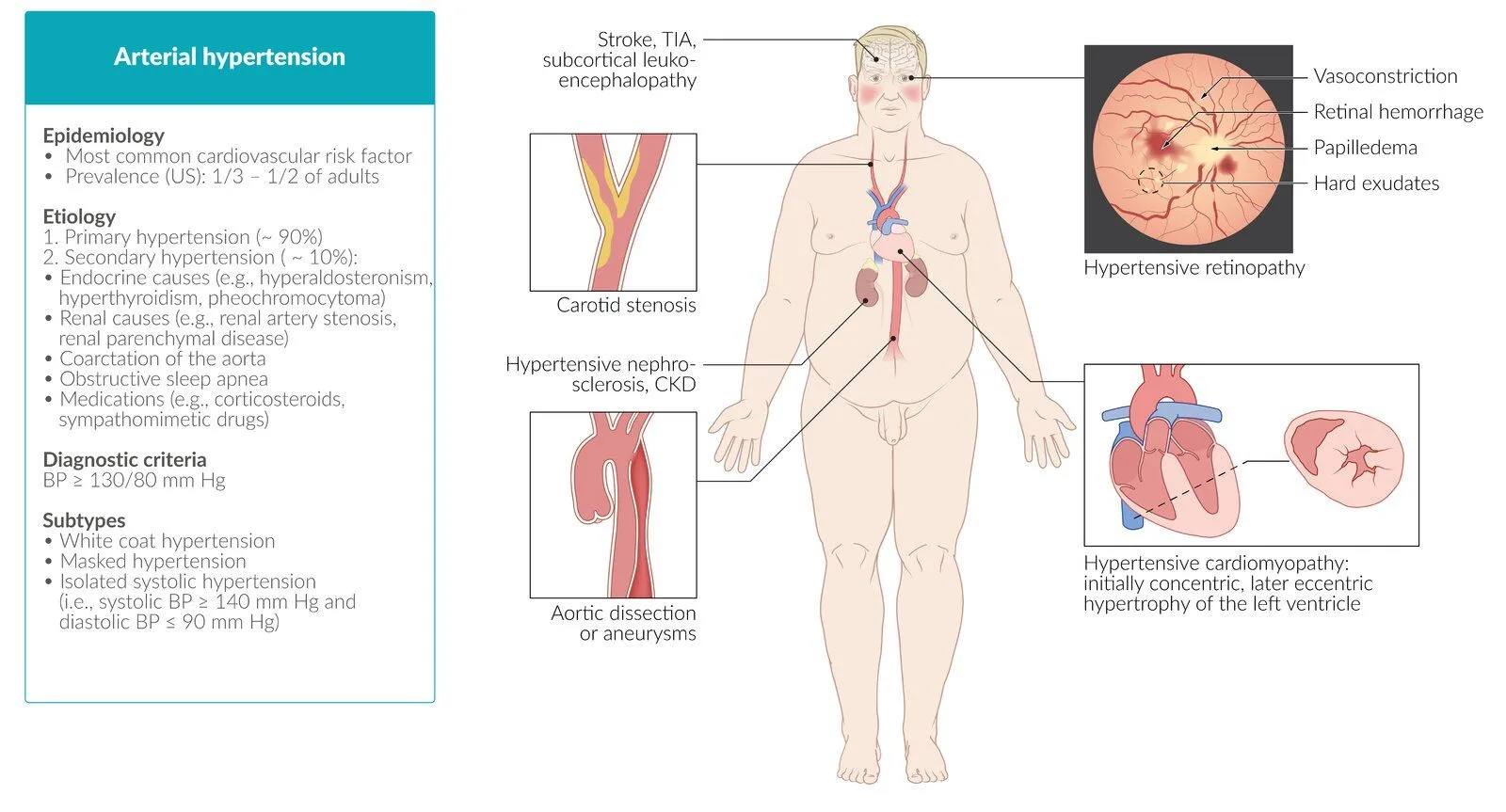
What this shows
Primary (essential) hypertension
~90 to 95% of cases, with no single cause.- Driven by genetics, obesity, sodium, alcohol and age-related arterial stiffness.
- It is silent for years and then shows up as stroke, myocardial infarction (MI), heart failure, chronic kidney disease (CKD) and retinopathy.
Isolated systolic hypertension
systolic blood pressure (SBP) ≥ 140 with diastolic blood pressure (DBP) < 90.- In older adults it is aortic stiffness.
- In a young adult think aortic regurgitation, hyperthyroidism, anemia or an arteriovenous (AV) fistula (wide pulse pressure).
- Treat it as seriously as any hypertension.
What sets each pressure
the Hypertension confirmation and BP determinants ties the confirmation pathway to the physiology.- Pulse pressure rises with stroke volume or stiff arteries.
- Diastolic pressure rises with systemic vascular resistance.
Modifiable risk factors
overweight/obesity (the greatest modifiable factor, especially central), uncontrolled diabetes, smoking, high-sodium/low-potassium diet, inactivity, chronic stress.- Excess alcohol (≥ 3 drinks/day in men, ≥ 2 in women) is the classic cause of "uncontrolled on two drugs".
Non-modifiable risk factors
family history, Black ancestry, advancing age.Screening and confirming the diagnosis
Screen every adult ≥ 18
how often depends on age and risk.- Ages 18 to 39 with normal blood pressure (BP) (< 130/85 mm Hg) and no risk factors: every 3 to 5 years.
- Anyone ≥ 40, or ≥ 18 with risk factors: annually.
- If an office reading is elevated, repeat in both arms and on a second visit.
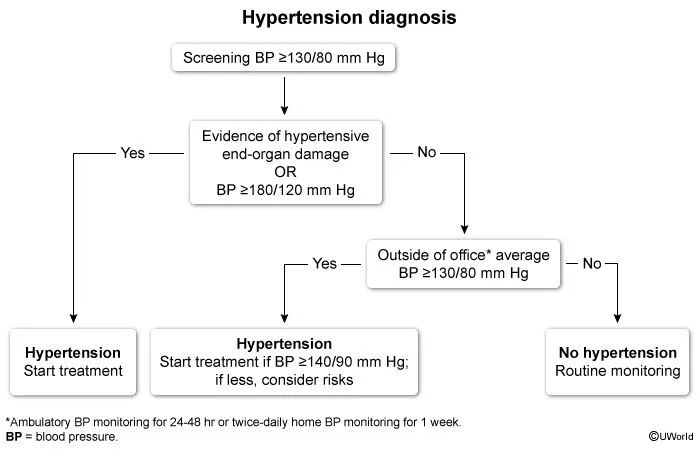
What this shows
Confirming the diagnosis
one office reading is not a diagnosis. Confirm out of office.- 24 to 48 h ambulatory BP monitoring (preferred): an automatic device worn continuously, reading every 15 to 60 minutes.
- Home BP: twice daily (morning and evening) for a week, if ambulatory monitoring is not available.
- Three automated office readings at least a week apart: if neither is possible, preferably with the patient alone.
Skip confirmation and diagnose immediately
when there is end-organ damage or BP ≥ 180/120.White-coat hypertension
office ≥ 130/80 (but < 160/100) with out-of-office < 130/80.- No drugs, recheck yearly.
- Ambulatory and home monitoring are preferred for confirmation because they separate true hypertension from white-coat hypertension.
Masked hypertension
normal in office, high outside; treat as true hypertension.Staging and the new-diagnosis workup
| Stage | Systolic | Diastolic | Action | |
|---|---|---|---|---|
| Normal | < 120 | and | < 80 | Nothing |
| Elevated | 120 to 129 | and | < 80 | Lifestyle for everyone |
| Stage 1 | 130 to 139 | or | 80 to 89 | Lifestyle for everyone; drugs only if high risk (clinical cardiovascular disease (CVD), diabetes, CKD, age > 65, 10-year atherosclerotic cardiovascular disease (ASCVD) risk ≥ 10%) |
| Stage 2 | ≥ 140 | or | ≥ 90 | Lifestyle plus drugs for everyone; start two agents if ≥ 20/10 above goal |
| Severe | ≥ 180 | or | ≥ 120 | Same-day evaluation, urgency vs emergency |
Stages at a glance
also summarized on the When table.New-diagnosis workup (every patient)
screens for secondary causes, end-organ damage and a baseline before drugs.- BMP (Na, K, Ca, Cl, blood urea nitrogen (BUN), creatinine/eGFR).
- Fasting glucose or HbA1c, lipid panel, thyroid-stimulating hormone (TSH).
- Urinalysis with albumin/creatinine ratio, complete blood count (CBC), uric acid.
- An electrocardiogram (ECG) for left ventricular hypertrophy (LVH).
- Echo only if there are signs of heart failure or LVH.
Pursue secondary causes
when onset is < 30 years, new diastolic hypertension after 65, abrupt or rapidly worsening course, resistant hypertension, or a clue such as hypokalemia, an abdominal bruit or hematuria.- Worked up on Secondary Hypertension.
Treatment: lifestyle and drugs
Lifestyle treatment (it is treatment, not filler)
in order of BP effect, as in the Lifestyle treatment table.- Dietary Approaches to Stop Hypertension (DASH) diet: ~11 mm Hg.
- Weight loss: ~6 mm Hg per 10 kg, aim body mass index (BMI) < 25; the most effective lifestyle approach in obese individuals.
- Aerobic exercise: 150 min/week, ~7 mm Hg.
- Sodium: < 1.5 to 2.3 g/day, ~5 to 8 mm Hg.
- Alcohol: ≤ 2/day men and ≤ 1/day women, ~5 mm Hg.
- Smoking cessation barely moves BP but is mandatory for cardiovascular risk.
| Measure | Plan | ≈ SBP reduction |
|---|---|---|
| DASH diet | Fruit, vegetables, low-fat dairy; low saturated fat | 11 mm Hg |
| Weight loss | BMI < 25 kg/m² | 6 mm Hg per 10 kg |
| Aerobic exercise | 30 min/day, ≥ 5 days/week | 7 mm Hg |
| Sodium restriction | < 1.5 to 2.3 g/day | 5 to 8 mm Hg |
| Alcohol limit | ≤ 2/day men, ≤ 1/day women | 5 mm Hg |
| Smoking cessation | Complete | Minimal on BP; large on cardiovascular (CV) risk |
When to start drugs
stage 2 for everyone; stage 1 only for high-risk patients.- Goal for most adults is < 130/80.
First line with no comorbidity
thiazide (chlorthalidone preferred), angiotensin-converting enzyme (ACE) inhibitor or angiotensin receptor blocker (ARB), or a dihydropyridine calcium-channel blocker (CCB).- Black patients without CKD/heart failure (HF) respond best to a thiazide or CCB.
- A thiazide is also preferred for isolated systolic hypertension.
- ARBs give the most LVH regression.
- Beta blockers are not first line without a cardiac indication.
Never combine an ACE inhibitor with an ARB or aliskiren
more hyperkalemia and renal injury, no extra benefit.Titrate
titrate or add a second class after 2 to 4 weeks; a fixed-dose combination improves adherence.- Classes, mechanisms and adverse effects on Antihypertensive Drugs.
De-prescribing
long-term control on one drug with good lifestyle adherence allows a slow taper with monthly checks.- But never stop beta blockers or clonidine abruptly (rebound).
| Comorbidity | Preferred | Avoid / notes |
|---|---|---|
| CKD, or diabetes with albuminuria | ACE inhibitor or ARB | Nephroprotective; check K and creatinine in 1 to 2 weeks |
| Diabetes without albuminuria | Any first-line agent | Target < 130/80 |
| Heart failure with reduced ejection fraction (HFrEF) | ACEi/ARB or angiotensin receptor-neprilysin inhibitor (ARNI) + beta blocker + mineralocorticoid receptor antagonist (MRA) + diuretic | Non-dihydropyridine CCBs worsen systolic function; beta blockers with caution in decompensated HF, contraindicated in cardiogenic shock |
| Heart failure with preserved ejection fraction (HFpEF) | Diuretic if congested; otherwise ACEi/ARB + beta blocker | Avoid nitrates |
| Stable angina | Beta blocker or CCB | |
| Post-MI | Beta blocker + ACE inhibitor/ARB | |
| Atrial fibrillation | Beta blocker or non-dihydropyridine (non-DHP) CCB | Rate control doubles as BP control |
| Black patients (no CKD/HF) | Thiazide or CCB | ACEi/ARB less effective as monotherapy |
| Asthma / chronic obstructive pulmonary disease (COPD) | ARB, CCB, thiazide | ACE inhibitor cough is unwelcome; beta blockers risk bronchospasm; cardioselective if essential |
| Osteoporosis | Thiazide | Lowers urinary calcium |
| Gout | Losartan (uricosuric), CCB, ACEi | Thiazides raise urate |
| Migraine | Beta blocker or CCB | |
| Benign prostatic hyperplasia (BPH) | Alpha-1 blocker | Orthostasis in the elderly |
| Pregnancy | Labetalol, nifedipine, methyldopa (hydralazine acutely) | ACEi/ARB/aliskiren are teratogenic |
Resistant hypertension and hypertensive crisis
Resistant hypertension
BP above goal on three drugs of different classes including a diuretic at maximal tolerated doses, or controlled only on four.First exclude pseudo-resistance
most "uncontrolled" patients are not truly resistant.- Non-adherence (about 40% of "uncontrolled" patients).
- White-coat effect and wrong cuff size.
- Lifestyle: alcohol, nonsteroidal anti-inflammatory drugs (NSAIDs), decongestants, oral contraceptives, high sodium.
True resistance
a fixed sequence.- Switch to chlorthalidone: if on hydrochlorothiazide.
- Add spironolactone.
- Screen for secondary causes: primary aldosteronism, renal artery stenosis, obstructive sleep apnea.
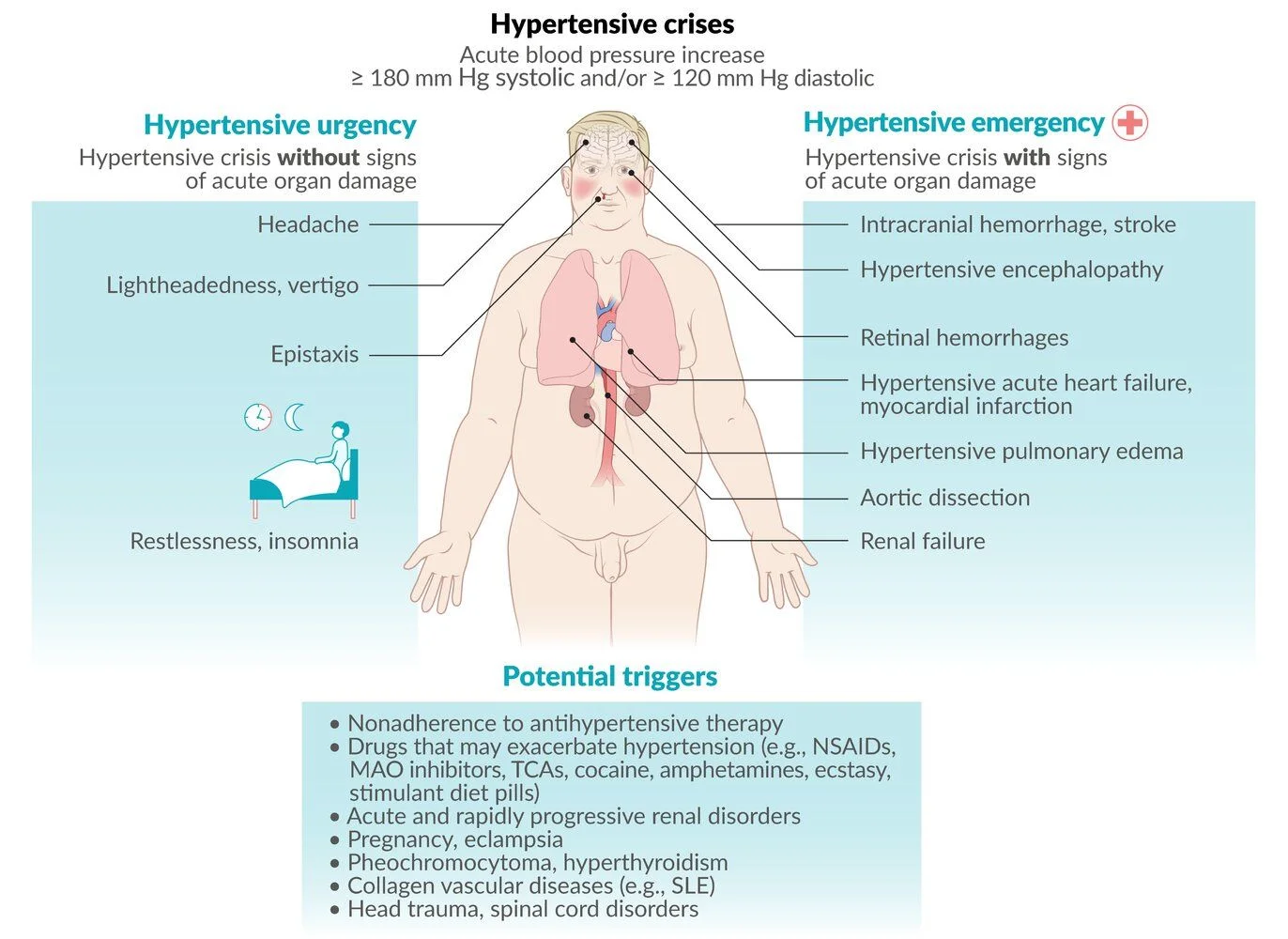
What this shows
Hypertensive crisis, urgency vs emergency
both are BP ≥ 180/120.- Urgency: no acute end-organ injury, so oral agents, lower over 24 to 48 h, outpatient follow-up.
- Emergency: acute injury (encephalopathy, stroke or hemorrhage, retinal hemorrhage/papilledema, acute coronary syndrome (ACS), pulmonary edema, dissection, acute kidney injury (AKI), eclampsia), so intensive care unit (ICU) and intravenous (IV) drugs.
How fast
faster drops cause cerebral, renal and coronary ischemia.- First hour: cut MAP by ~10 to 20%.
- First 24 h: no more than 25% in total.
- By 2 to 6 h: to 160/100.
- Over days: to normal.
IV agents
nicardipine, clevidipine, labetalol, esmolol, nitroprusside (cyanide with prolonged use, avoid in renal failure), hydralazine, fenoldopam, nitroglycerin, enalaprilat.Hypertensive encephalopathy
failed cerebral autoregulation, then vasogenic edema.- Headache, confusion, seizures, papilledema.
- Magnetic resonance imaging (MRI) may show posterior reversible encephalopathy syndrome (PRES).
- Reversible if pressure is lowered in time.
| Situation | Preferred agent | Target and trap |
|---|---|---|
| Aortic dissection | Esmolol or labetalol first, then nicardipine/nitroprusside | Heart rate (HR) < 60 and SBP < 120 within the first hour; beta blocker before any vasodilator (Aortic Dissection) |
| Acute pulmonary edema | Nitroglycerin + loop diuretic, nitroprusside | Avoid beta blockers acutely |
| ACS | Nitroglycerin, beta blocker | Avoid nitrates if right ventricular (RV) infarct or recent phosphodiesterase-5 (PDE-5) inhibitor |
| Ischemic stroke | Treat only if > 220/120 (or > 185/110 before thrombolysis) | Permissive hypertension protects the penumbra |
| Intracerebral hemorrhage | Nicardipine | SBP ~140 |
| Hypertensive encephalopathy / PRES | Nicardipine, labetalol | No more than 25% in 24 h |
| Sympathomimetic (cocaine, amphetamine) | Benzodiazepines, then nitroglycerin/phentolamine | Avoid beta blockers (unopposed alpha) |
| Pheochromocytoma | Phentolamine, nicardipine | Alpha blockade before beta blockade |
| Pre-eclampsia / eclampsia | IV labetalol, hydralazine, oral nifedipine + magnesium | Deliver; no ACEi/nitroprusside |
| Scleroderma renal crisis | Oral ACE inhibitor (captopril) | The one crisis where ACE inhibition is the answer |
Complications and special populations
Complications
hypertension damages the heart, vessels, kidneys, eyes and aorta.- Concentric LVH, then HFpEF and atrial fibrillation.
- Accelerated atherosclerosis: coronary artery disease (CAD), stroke, peripheral artery disease (PAD).
- Nephrosclerosis with proteinuric CKD.
- Retinopathy: AV nicking, copper wiring, hemorrhages, papilledema in malignant hypertension.
- Aortic aneurysm and dissection.
Follow-up
recheck monthly until at goal, then every 3 to 6 months.- Check the BMP within weeks of starting an ACE inhibitor, ARB or diuretic.
Pediatric
hypertension is BP ≥ 95th percentile for age, sex and height; screen yearly from age 3.- Secondary causes dominate in prepubertal children: renal parenchymal disease first, then renovascular disease and coarctation.
- Primary hypertension emerges in obese adolescents.
Older adults
treat to the same goal if tolerated, but watch orthostasis.- Start low, go slow, and check standing pressures.
A patient has a BP of 210/130 with headache, confusion and papilledema. Is this urgency or emergency, where is it treated, and how far can the pressure be lowered in the first 24 hours?
A hypertensive emergency: BP ≥ 180/120 with acute end-organ injury (encephalopathy, papilledema). Treat in the ICU with IV drugs (nicardipine or labetalol), cutting mean arterial pressure by about 10 to 20% in the first hour and no more than 25% in the first 24 hours, because faster drops cause cerebral, renal and coronary ischemia.
How it's tested
A well 35-year-old with one office reading of 148/92: confirm with ambulatory monitoring before diagnosing or treating — unless BP is ≥ 180/120 or there is end-organ damage.
A diabetic with albuminuria; a Black patient without CKD; a pregnant woman: ACE inhibitor/ARB; thiazide or CCB; labetalol/nifedipine/methyldopa. Comorbidity picks the drug.
Blood pressure 210/130 with headache, confusion and papilledema: hypertensive emergency — IV nicardipine or labetalol in the ICU, no more than a 25% MAP drop in 24 hours.
Tearing chest pain to the back with BP 190/110: esmolol or labetalol first to cut heart rate and shear, then a vasodilator; never the vasodilator first.
Uncontrolled on hydrochlorothiazide, amlodipine and lisinopril in a man who drinks six beers a night: address adherence and alcohol before adding spironolactone; if truly resistant, spironolactone and a secondary-cause screen.
Go deeper
Guidelines: 2025 ACC/AHA High Blood Pressure in Adults Guideline
Related Step 2 pages: Secondary Hypertension, Antihypertensive Drugs, Aortic Dissection, Coarctation of Aorta, Heart Failure, Hyperlipidemia
High-yield images6
Flashcards for this page
Card 1 of 5 · try-out only, nothing is saved
You just read one page of 236
The rest of Step 2 CK, written exactly like this.
Rapid Review is the reading layer of a full Step 1 platform: a schedule fitted to your exam date, flashcards for every page, and a mentor a message away.
Every Step 1 system
Written the same way: what to know, how it’s tested, where to go deeper.
A plan built to your exam date
Tell us when you sit, and the schedule fits the whole library and your question bank to it.
Flashcards for every page
Ready-made spaced-repetition decks linked to each topic, so nothing you read gets forgotten.
