
Rapid Review·Cardiovascular
Select any text to highlight it or add a note.
Valvular Heart Disease
T1Must knowMitral Valve Prolapse
Focus on
A mid-systolic click that moves earlier (and a murmur that gets louder) when the patient stands, later and softer when they squat. Usually benign — reassurance, no endocarditis prophylaxis — but it is the most common cause of primary mitral regurgitation in developed countries, so know when the click has become a disease.
Key takeaways
What it is and what causes it
Mitral valve prolapse
myxomatous degeneration leaves the mitral leaflets redundant, so they prolapse into the left atrium.Primary
idiopathic or familial.Secondary
connective tissue disease (Marfan, Ehlers-Danlos), Klinefelter syndrome, anorexia nervosa.Clinical features
Most patients are asymptomatic
it can progress to mitral regurgitation.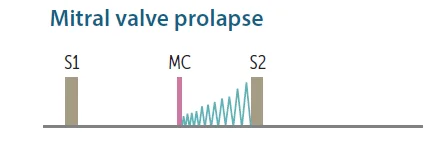
What this shows
The sound
a mid-systolic click followed by a mitral regurgitation murmur.Maneuvers change the timing
ventricular volume decides when the click comes.- Standing or Valsalva (less ventricular volume) moves the click earlier and makes the murmur louder.
- Squatting (more volume) moves the click later and softens the murmur.
| Maneuver | Ventricular volume | Click | Murmur |
|---|---|---|---|
| Standing or Valsalva | Less | Earlier | Louder |
| Squatting | More | Later | Softer |
Diagnosis and management
Transthoracic echocardiography
confirms it.Management
reassurance and monitoring.No antibiotic prophylaxis
the small rise in endocarditis risk does not earn antibiotic prophylaxis, even for dental work.A thin 23-year-old woman has palpitations and a mid-systolic click followed by a short murmur; the click moves closer to S1 when she stands. What is the diagnosis, how is it confirmed, and does she need antibiotics before dental work?
Mitral valve prolapse (standing lowers ventricular volume, so the click comes earlier and the murmur gets louder). Confirm with transthoracic echocardiography; manage with reassurance and monitoring. No antibiotic prophylaxis, even for dental work.
How it's tested
A thin 24-year-old woman with palpitations and a mid-systolic click that moves closer to S1 when she stands: mitral valve prolapse — echo to grade MR; reassurance if trivial.
Does she need antibiotics before a dental cleaning: no.
Tall man with arachnodactyly, lens dislocation and a late systolic murmur: Marfan syndrome with MVP — also image the aortic root.
MVP with a new holosystolic murmur, dyspnea and an EF of 58%: severe primary MR with early LV dysfunction — mitral valve repair.
Sudden pulmonary edema in a known MVP patient with a new loud murmur: ruptured chordae tendineae — acute severe MR; urgent surgery.
Go deeper
Guidelines: 2020 ACC/AHA Valvular Heart Disease Guideline
Related Step 2 pages: Mitral Regurgitation, Heart Sounds & Murmurs, Hypertrophic Cardiomyopathy, Infective Endocarditis
High-yield images1
You just read one page of 236
The rest of Step 2 CK, written exactly like this.
Rapid Review is the reading layer of a full Step 1 platform: a schedule fitted to your exam date, flashcards for every page, and a mentor a message away.
Every Step 1 system
Written the same way: what to know, how it’s tested, where to go deeper.
A plan built to your exam date
Tell us when you sit, and the schedule fits the whole library and your question bank to it.
Flashcards for every page
Ready-made spaced-repetition decks linked to each topic, so nothing you read gets forgotten.
