
Rapid Review·Cardiovascular
Select any text to highlight it or add a note.
Inflammatory & Infective Disease
T2High yieldMyocarditis
Focus on
A young adult with a viral prodrome, then chest pain, a troponin rise, new heart failure or arrhythmia, and global hypokinesis on echo with clean coronaries. Supportive heart-failure care and rest; biopsy only when it changes therapy (giant-cell, eosinophilic, sarcoid). The complication is dilated cardiomyopathy and sudden death.
Key takeaways
What it is and what causes it
Myocarditis
inflammation of the myocardium, often with cardiac dysfunction.Viral infection is the most common cause
coxsackie B, adenovirus, influenza, cytomegalovirus, Epstein-Barr virus, parvovirus.- Idiopathic cases are presumed viral.
Other infections
parasitic (Chagas disease) and bacterial (Borrelia burgdorferi, Corynebacterium diphtheriae).Autoimmune
Kawasaki disease, sarcoidosis, systemic lupus erythematosus, polymyositis or dermatomyositis.Drugs
doxorubicin, cocaine.Clinical features
Often asymptomatic
most common in young adults.A viral prodrome first
a flu-like illness in the preceding 1 to 2 weeks.Then the heart
chest pain, features of acute heart failure (dyspnea, orthopnea, edema), and arrhythmias such as sinus tachycardia.Diagnosis
Initial workup for suspected viral myocarditis
an electrocardiogram (ECG), chest radiograph and echocardiogram.ECG
abnormal but non-specific (sinus tachycardia, atrioventricular block).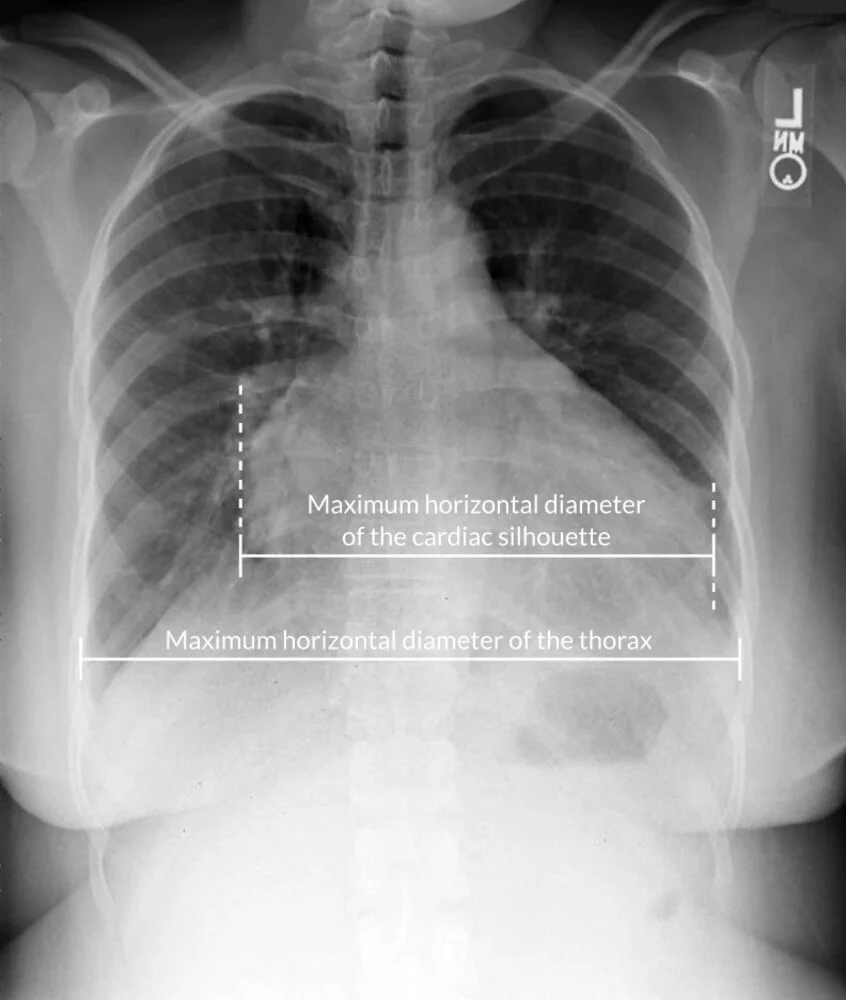
What this shows
Chest radiograph
cardiomegaly (cardiothoracic ratio over 50 percent).Echocardiography
four findings.- Global hypokinesis.
- Four-chamber dilation.
- A reduced ejection fraction.
- Sometimes a pericardial effusion.
Labs
raised troponin, creatine kinase-MB and B-type natriuretic peptide (BNP), a raised erythrocyte sedimentation rate (ESR) and leukocytosis.Definitive diagnosis
one of two tests.- Cardiac magnetic resonance imaging (MRI): late enhancement of the epicardium.
- Endomyocardial biopsy: lymphocytic infiltrate.
Management and complications
Admit
supportive care (pain control, heart failure treatment) and treatment of the cause.Dilated cardiomyopathy
with heart failure (Dilated Cardiomyopathy), and sudden cardiac death.Children do worse
progression to heart failure and death are much more common in children.A young adult had a flu-like illness 10 days ago and now has chest pain, dyspnea and sinus tachycardia; echo shows global hypokinesis, four-chamber dilation and a low ejection fraction. What is the most likely cause, which test is the gold standard, and what is the feared long-term complication?
Viral myocarditis (coxsackie B is the classic virus). Endomyocardial biopsy (lymphocytic infiltrate) is the gold standard, but treatment starts on clinical suspicion. The feared complication is dilated cardiomyopathy with heart failure, and sudden cardiac death.
How it's tested
A 24-year-old with a flu-like illness two weeks ago now has chest pain, a troponin of 3 ng/mL, sinus tachycardia and global hypokinesis with EF 35%; coronaries are normal: viral myocarditis — admit, heart-failure therapy, no NSAIDs, no sport for months.
Same patient in cardiogenic shock on day 2 with sustained VT: fulminant myocarditis — mechanical support; biopsy to look for giant-cell disease, which needs immunosuppression.
Facial palsy, erythema migrans a month ago, now complete heart block: Lyme carditis — IV ceftriaxone and temporary pacing; the block resolves.
Melanoma patient on nivolumab with myalgias, a CK of 8,000, troponin rise and new AV block: immune checkpoint inhibitor myocarditis — stop the drug and give high-dose glucocorticoids.
Immigrant from Bolivia with heart failure, RBBB, an apical LV aneurysm and megacolon: chronic Chagas cardiomyopathy.
Go deeper
Guidelines: 2025 ESC Myocarditis and Pericarditis Guideline
Related Step 2 pages: Acute Pericarditis, Dilated Cardiomyopathy, Heart Failure, Atrioventricular Block, Ventricular Tachycardia
High-yield images1
Flashcards for this page
Card 1 of 5 · try-out only, nothing is saved
You just read one page of 236
The rest of Step 2 CK, written exactly like this.
Rapid Review is the reading layer of a full Step 1 platform: a schedule fitted to your exam date, flashcards for every page, and a mentor a message away.
Every Step 1 system
Written the same way: what to know, how it’s tested, where to go deeper.
A plan built to your exam date
Tell us when you sit, and the schedule fits the whole library and your question bank to it.
Flashcards for every page
Ready-made spaced-repetition decks linked to each topic, so nothing you read gets forgotten.
