
Rapid Review·Cardiovascular
Select any text to highlight it or add a note.
Inflammatory & Infective Disease
T1Must knowAcute Rheumatic Fever & Rheumatic Heart Disease
Focus on
A child 2–4 weeks after strep pharyngitis with migratory polyarthritis, carditis, chorea, erythema marginatum or nodules — the Jones criteria plus evidence of the streptococcal infection. Penicillin now, penicillin prophylaxis for years, and decades later the mitral stenosis of rheumatic heart disease.
Key takeaways
What it is
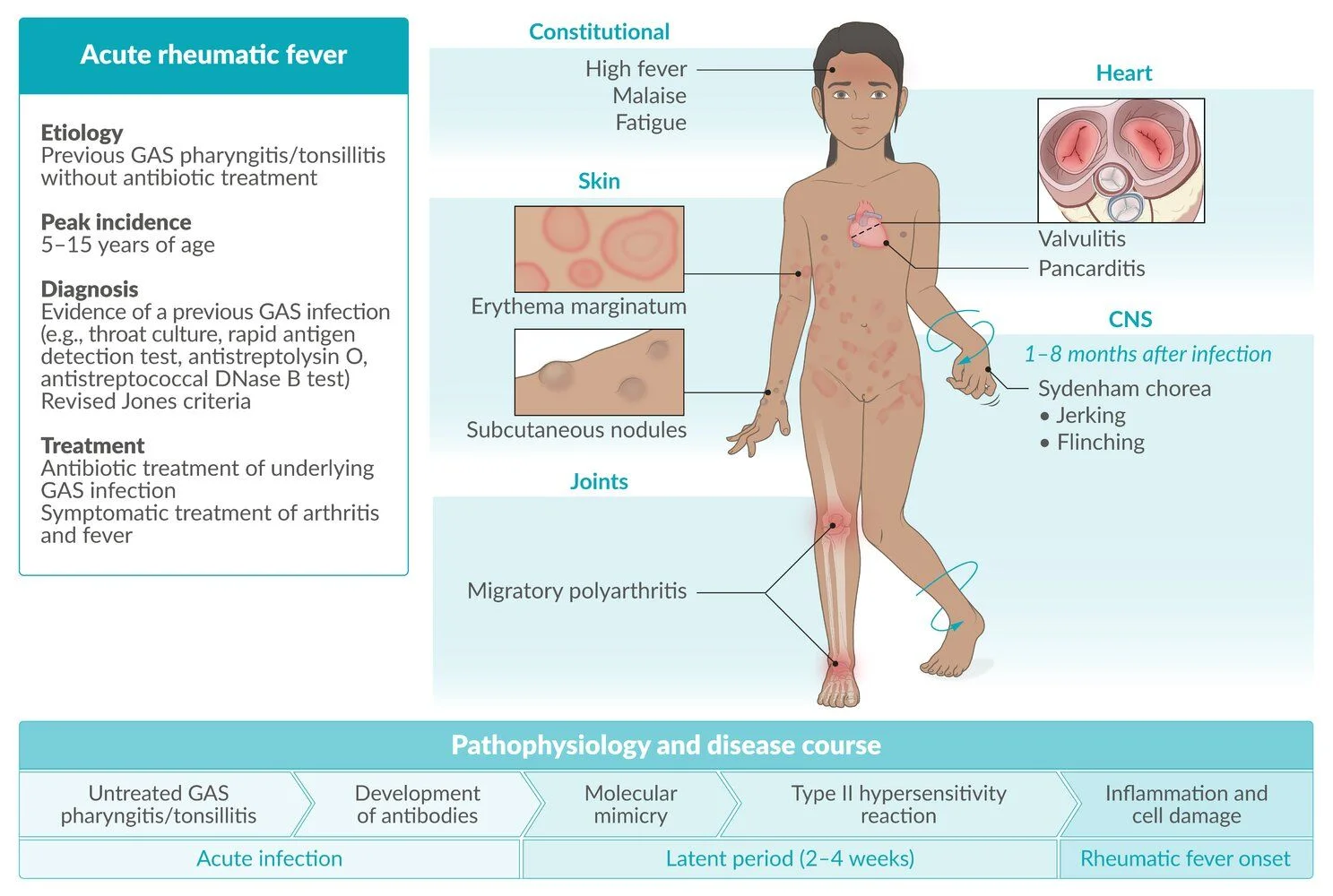
What this shows
Acute rheumatic fever
a delayed inflammatory complication of group A streptococcal (GAS) pharyngitis, usually 1 to 5 weeks after the infection, peaking at age 5 to 15.The high-pressure valves suffer most
mitral first, then aortic, rarely tricuspid.Early leak, late narrowing
acute rheumatic fever causes early regurgitation; rheumatic heart disease causes late stenosis.Diagnosis (Jones criteria)
Definitive diagnosis
two major criteria, or one major plus two minor, with evidence of a recent GAS infection.| Major | Minor |
|---|---|
| Joints: migratory polyarthritis | Fever |
| O (heart): pancarditis (endocarditis, pericarditis, myocarditis) | Raised erythrocyte sedimentation rate (ESR) |
| Nodules: subcutaneous | Polyarthralgia |
| Erythema marginatum | Prolonged PR interval |
| Sydenham chorea |
Erythema marginatum
the evanescent, non-itchy, serpiginous rash in the Erythema marginatum.Confirm the recent infection
an antistreptolysin O (ASO) or anti-DNase B titer, a positive throat culture, or a positive rapid antigen test.Sydenham chorea
Mechanism
molecular mimicry between anti-GAS antibodies and basal ganglia antigens.Features
involuntary jerky movements that worsen when awake and with action.- Hypotonia, emotional lability and obsessive-compulsive behavior.
- With or without the other features of rheumatic fever.
- It can appear late (1 to 8 months after the infection).
Diagnosis
clinical, plus evidence of prior GAS (throat culture, ASO, anti-DNase B).- Check the heart with echocardiography and an electrocardiogram (ECG).
Treatment
chronic penicillin and, for symptoms, an antidopaminergic (haloperidol).Course
it usually remits on its own but recurs often, and carditis raises the risk of rheumatic heart disease.Management and prophylaxis
Eradicate the streptococcus
first line is penicillin V orally or penicillin G intramuscularly.- Penicillin allergy: a cephalosporin for mild hypersensitivity, or a macrolide (clarithromycin) for anaphylaxis to beta-lactams.
Prevention
treating streptococcal pharyngitis with penicillin prevents acute rheumatic fever.Secondary prophylaxis for every patient who has had acute rheumatic fever
intramuscular penicillin G every 4 weeks or oral penicillin V daily.- Sulfadiazine or a macrolide if allergic.
| Condition | Duration |
|---|---|
| Rheumatic fever without carditis | Until age 21, or 5 years |
| Rheumatic fever with carditis | Until age 21, or 10 years |
| Rheumatic fever with carditis and valve disease | Until age 40, or 10 years |
Three weeks after a sore throat, a 9-year-old has fever, a knee swelling that settles as the ankle swells, and a new murmur; the ASO titer is raised. What is the diagnosis, what is the first-line drug, and how long is prophylaxis if echo shows carditis with valve disease?
Acute rheumatic fever (two major criteria, migratory polyarthritis and carditis, plus evidence of GAS infection). Eradicate the streptococcus with penicillin V orally or penicillin G intramuscularly, then give secondary prophylaxis until age 40 or for 10 years, whichever is longer.
How it's tested
An 8-year-old with fever and a swollen knee that improved as the ankle swelled, three weeks after a sore throat, with a new apical holosystolic murmur: acute rheumatic fever (two majors) — confirm with ASO/anti-DNase B, echo, penicillin, aspirin, then monthly benzathine penicillin.
A 10-year-old girl with new fidgeting, facial grimacing and emotional lability, no other findings, positive anti-DNase B: Sydenham chorea — diagnostic on its own; penicillin prophylaxis and echo.
How long is prophylaxis for a child with carditis and residual mitral regurgitation: 10 years or to age 40, whichever is longer.
A 35-year-old immigrant woman becomes breathless in her second trimester; opening snap and diastolic rumble at the apex: rheumatic mitral stenosis unmasked by pregnancy.
Does treating strep pharyngitis prevent rheumatic fever: yes — penicillin within 9 days of symptom onset; it does not prevent post-streptococcal glomerulonephritis.
Go deeper
Guidelines: 2020 AHA Scientific Statement on Rheumatic Heart Disease
Related Step 2 pages: Mitral Stenosis, Mitral Regurgitation, Infective Endocarditis, Myocarditis, Acute Pericarditis, Heart Sounds & Murmurs
High-yield images2
Flashcards for this page
Card 1 of 5 · try-out only, nothing is saved
You just read one page of 236
The rest of Step 2 CK, written exactly like this.
Rapid Review is the reading layer of a full Step 1 platform: a schedule fitted to your exam date, flashcards for every page, and a mentor a message away.
Every Step 1 system
Written the same way: what to know, how it’s tested, where to go deeper.
A plan built to your exam date
Tell us when you sit, and the schedule fits the whole library and your question bank to it.
Flashcards for every page
Ready-made spaced-repetition decks linked to each topic, so nothing you read gets forgotten.
