
Rapid Review·Cardiovascular
Select any text to highlight it or add a note.
Vascular: Aorta & Carotid
T1Must knowThoracic Aortic Aneurysm
Focus on
Usually silent until it presses on something — hoarseness, dysphagia, stridor, SVC syndrome — regurgitates through a stretched aortic valve, or dissects. Marfan, bicuspid valve, hypertension and syphilis are the causes; a widened mediastinum on the film and CT angiography make the diagnosis; repair at 5.5 cm (lower thresholds for the genetic aortopathies) or fast growth.
Key takeaways
What it is and who gets it
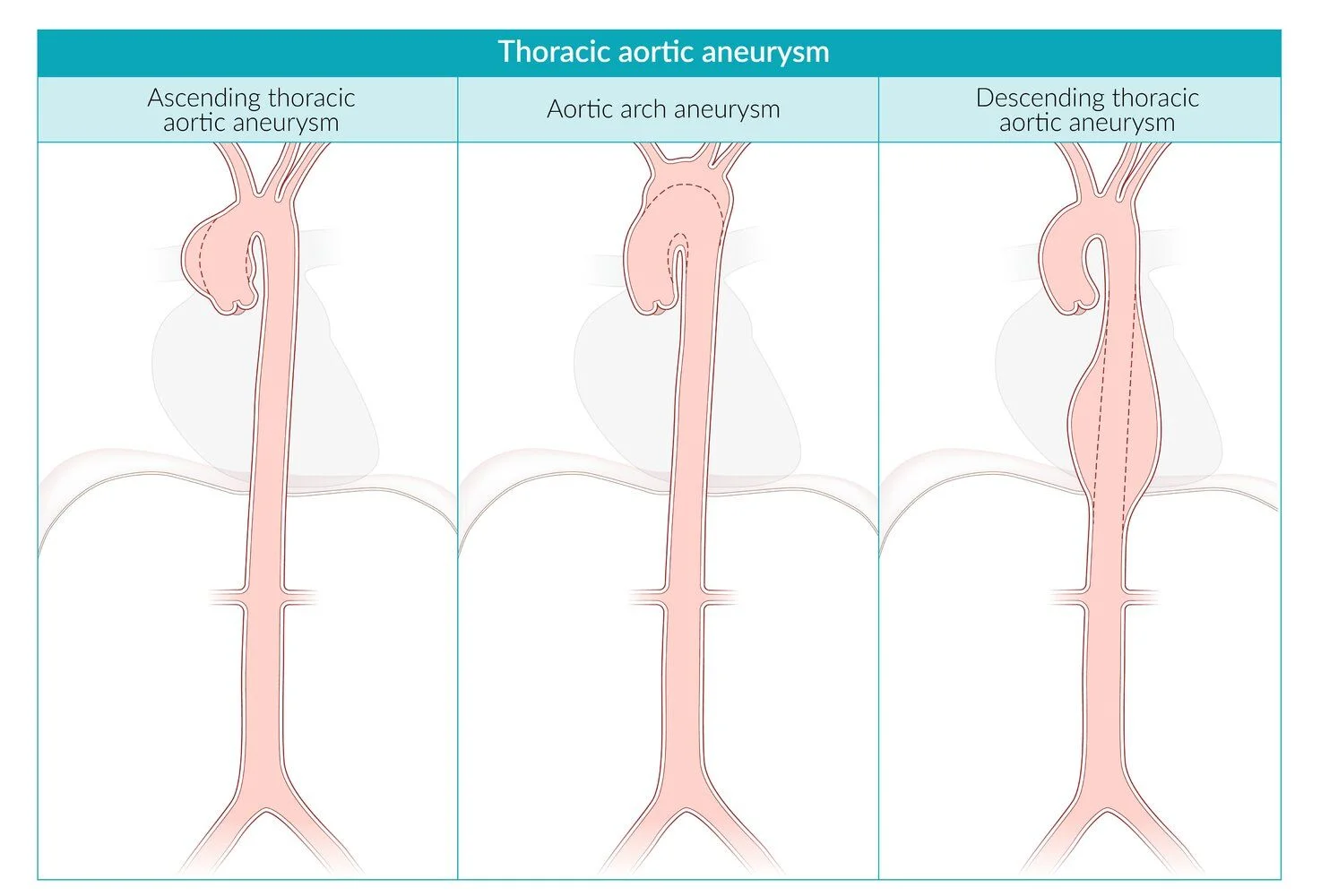
What this shows
Thoracic aortic aneurysm
dilation of all three layers of the thoracic aorta to over 150 percent of normal: roughly over 5 cm ascending, over 4 cm descending.Two patterns
ascending aneurysms are usually cystic medial degeneration (genetic or hypertensive); descending aneurysms are usually atherosclerotic.Risk factors
atherosclerosis (hypertension, smoking, age over 60), Marfan and Ehlers-Danlos syndromes, Turner syndrome, bicuspid aortic valve, vasculitis (giant-cell arteritis), tertiary syphilis (calcified "tree-bark" ascending aorta).Clinical features
Often asymptomatic
an incidental finding on a chest film or echo.Rupture or impending rupture
chest pressure, thoracic back pain.Mediastinal compression
five structures.- Dysphagia (esophagus).
- Superior vena cava syndrome (upper venous congestion).
- Hoarseness (recurrent laryngeal nerve).
- Cough, wheeze or stridor (trachea).
- Horner syndrome (sympathetic trunk).
Other consequences
aortic regurgitation from root dilation; thromboembolism from wall thrombus; rupture can complicate into dissection with hypotension and shock.Diagnosis
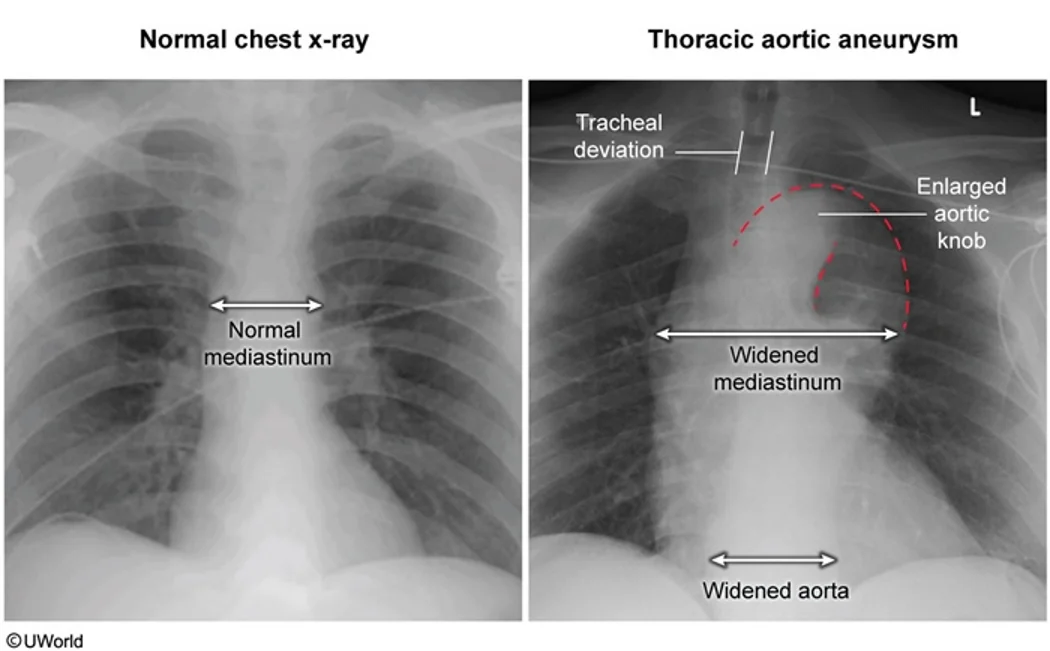
What this shows
Chest radiograph is the initial test
abnormal aortic contour, widened mediastinum, tracheal deviation.Computed tomography (CT) angiography of the chest is the best confirmatory test
and the preferred test for any mediastinal widening or mass on a film; magnetic resonance angiography (or transesophageal echo) is the alternative.Transthoracic echocardiography
for the root and valve, and in an unstable patient.Work up the cause
syphilis serology, inflammatory markers, genetic testing in the young or syndromic.Management
Unstable
emergent surgery.Stable but symptomatic
urgent repair.Asymptomatic
surgery for 5.5 cm or more (thresholds differ by segment and cause) or rapid expansion (over 1 cm/year or over 0.5 cm in 6 months); otherwise serial imaging.Lower thresholds in the genetic aortopathies
5.0 cm in Marfan (4.5 with a family history of dissection or planned pregnancy), 5.0 in bicuspid valve with risk factors, and 4.5 when valve surgery is already planned.Medical
tight blood pressure control with beta blockers (slow root growth in Marfan, plus losartan), statin, smoking cessation, avoid strenuous isometric exercise and fluoroquinolones.Repair
open root or ascending replacement (valve-sparing or a composite graft); thoracic endovascular aortic repair (TEVAR) for descending aneurysms.Complications
dissection, rupture (into the pleura, pericardium, esophagus or bronchus), aortic regurgitation, thromboembolism.- After repair: stroke and paraplegia from spinal cord ischemia (descending repairs).
A 32-year-old man with Marfan syndrome has an asymptomatic ascending aortic diameter of 5.1 cm on echo. Does he need surgery, and which drugs slow root growth?
Yes: in Marfan the threshold is 5.0 cm (4.5 with a family history of dissection or planned pregnancy), lower than the usual 5.5. Beta blockers (plus losartan) slow root growth; avoid isometric exercise and fluoroquinolones.
How it's tested
A 30-year-old tall man with a family history of sudden death, a diastolic murmur and a 5.2-cm aortic root: Marfan aortopathy — elective root replacement (threshold 5.0), beta blocker and ARB meanwhile, avoid contact sports.
Progressive hoarseness and dysphagia in a hypertensive smoker; the film shows a widened mediastinum: thoracic aortic aneurysm compressing the recurrent laryngeal nerve and esophagus — CT angiography.
An elderly man with a calcified dilated ascending aorta, AR and a history of untreated syphilis: syphilitic aortitis — serology, penicillin, and aneurysm repair by size.
Bicuspid valve patient scheduled for AVR with a 4.7-cm ascending aorta: replace the aorta at the same operation (threshold 4.5 with valve surgery).
Sudden severe chest pain and hypotension in a man with a known 6.5-cm aneurysm: rupture or dissection — emergency surgery.
Go deeper
Guidelines: 2022 ACC/AHA Aortic Disease Guideline
Related Step 2 pages: Approach to Aortic Syndromes, Aortic Dissection, Abdominal Aortic Aneurysm, Aortic Regurgitation, Bicuspid Aortic Valve, Traumatic Aortic Injury
High-yield images2
You just read one page of 236
The rest of Step 2 CK, written exactly like this.
Rapid Review is the reading layer of a full Step 1 platform: a schedule fitted to your exam date, flashcards for every page, and a mentor a message away.
Every Step 1 system
Written the same way: what to know, how it’s tested, where to go deeper.
A plan built to your exam date
Tell us when you sit, and the schedule fits the whole library and your question bank to it.
Flashcards for every page
Ready-made spaced-repetition decks linked to each topic, so nothing you read gets forgotten.
